Joint report by Justice for Journalists Foundation and BAJ: “Attacks on media representatives in Belarus in 2025”
 10 March 2026
Attacks through judicial and/or economic mechanisms remain the main method of pressure on journalists — they account for 95% of all recorded incidents.
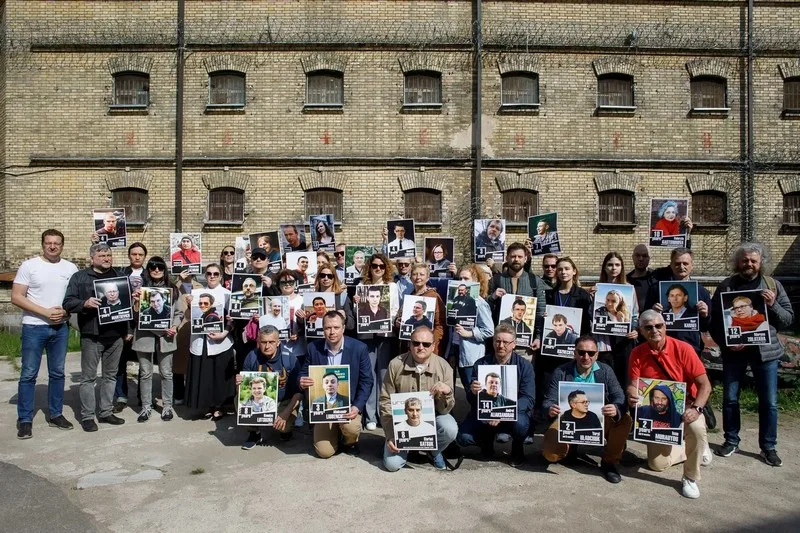
Solidarity action with politically imprisoned journalists. Lukiškės prison, Vilnius, may 3, 2024. Photo: BAJ
1/ KEY FINDINGS
In 2025, 478 cases of attacks/threats against professional and citizen media workers, as well as against editorial offices of traditional and online media outlets in Belarus and against Belarusian journalists in exile, were identified and analysed. Data for the study was collected using content analysis from open sources in three languages: Belarusian, Russian and English. The list of main sources is provided in Appendix 1.
- Attacks via judicial and/or economic means remain the prevailing method of pressure (95% of all incidents).
- According to the Belarusian Association of Journalists, as of February 2026, 28 media workers remain behind bars in Belarus.
- Pressure is directed at media workers who were forced into exile, with the Belarusian authorities employing so‑called “special proceedings” as a tool of repression.
- In 2025, an intensification of in absentia criminal prosecution of media workers who have left the country intensified.
- The Ministry of Information of Belarus continued to expand the National List of Extremist Materials, as well as List of Citizens of the Republic of Belarus, Foreign Citizens and Stateless Persons Involved in Extremist Activities.
2/ THE POLITICAL SITUATION AND THE MEDIA IN BELARUS
The situation regarding freedom of expression and independent media in Belarus remains among the worst in the world. In the 2025 Press Freedom Index, Belarus ranks 166th out of 179 countries. According to the Committee to Protect Journalists (CPJ), Belarus is the fifth‑worst country globally in terms of the number of journalists behind bars, and the second‑worst in Europe and Central Asia. In line with the report by Reporters Without Borders, as of 1 December 2025 Belarus ranked fourth in the world for the number of journalists in detention.
In June, September and December 2025, the Belarusian authorities, under an agreement with the US government, released 189 political prisoners (as of early 2026, more than 1,130 people recognised as political prisoners remain in places of detention in Belarus). On 21 June, among the 14 political prisoners released and immediately expelled to Lithuania was the former Radio Svaboda journalist Ihar Karnei.
On 11 September, 52 political prisoners were released, among them twelve media workers and bloggers: Iryna Slavnikava, Mikola Dziadok, Pavel Mazhejka, Aliaksandr Mantsevich, Larysa Shchyrakova, Yauhen Merkis, Alena Tsimashchuk, Viachaslau Lazareu, Pavel Padabed, Ihar Losik, Dzmitry Kazlou and Pavel Vinahradau. It should be noted that most of the former prisoners were deprived of their identity documents, and all were denied the possibility of choosing their country of residence. As in June, the so‑called “release” was in fact a deportation (expulsion from the Republic of Belarus).
On 13 December, a further 123 political prisoners were released and deported from Belarus. Among those freed in December was the former editor‑in‑chief of what was once the country’s largest online portal, TUT.BY, Maryna Zolatava, who spent four and a half years in detention on politically motivated charges (the outlet’s director, Liudmila Chekina, sentenced to 12 years of imprisonment, remains behind bars), as well as BAJ members Ales Bialiatski (Nobel Peace Prize laureate) and Aliaksandr Feduta (publicist and literary scholar).
However, according to Andrei Bastunets, Chairperson of the Belarusian Association of Journalists, they were“…effectively deported from the country along with other freed political prisoners on unclear legal grounds and without any documents or explanations.” Thus, the enforced exile has become yet another method of elimination of independent journalism from inside the country.
Repression against media professionals continues. In February 2026, trials are scheduled for at least three media workers.
Pressure is also exerted on those media workers who were forced to leave the country. The Belarusian authorities use so‑called “special proceedings” as a tool of repression — in absentia criminal prosecution of journalists, activists and politicians in exile, which may include the confiscation of their property. The Belarusian Association of Journalists is aware of roughly 100 cases of in absentia criminal prosecution of independent Belarusian journalists in exile since 2020 (the initiation of criminal cases and the start of special proceedings). Some journalists prefer not to disclose information about their prosecution for security reasons.
Families of those who were forced to flee the country are also subjected to pressure: searches are carried out at their homes, they receive police summonses, and face threats and intimidation.
To obstruct the work of independent media, the authorities continue to apply anti‑extremism legislation. Most independent media outlets and media organisations have been designated as “extremist formations”. In addition, the authorities classify the informational output of Belarusian media, other organisations and individuals as “extremist materials”. Subscribing to “extremist” outlets is equated with supporting extremist formations and may lead to criminal liability.
Thus, the key outcomes of 2025 for Belarusian media and journalists were:
- the beginning of the process of releasing journalists who are political prisoners; however, those released are deprived of the right to choose where they live — they are forcibly removed from Belarus;
- at the same time, the continuation of criminal prosecution both of media professionals and of ordinary citizens for expressing their opinions; an intensification of the practice of in absentia criminal prosecution of media workers who have left the country;
- the active use of anti‑extremism legislation to suppress freedom of expression, including by bringing citizens to criminal liability for the “distribution of extremist materials” (on social media and elsewhere) and for cooperation with “extremist formations”, a label the authorities have applied to almost all leading independent media;
- a heightened climate of fear in Belarus (relatives of journalists who are being prosecuted or have already been convicted are afraid to pass information to the media due to threats of harsher sentences or worsening conditions for their loved ones in detention if publications appear in the press);
- the strengthening of state propaganda in Belarus, the continued use of “confessional videos”, intensified cyber‑attacks, and the use of fake accounts and disinformation campaigns to discredit opponents of the authorities.
3/ GENERAL ANALYSIS OF ATTACKS
In 2025, the number of recorded attacks on Belarusian journalists and media outlets increased significantly compared with previous years. Relative to 2024, the number of attacks rose by 36%. This occurred despite the fact that five years had passed since the suppression of the post‑election protests in 2020 and that new presidential elections were held in 2025 — developments that might have been expected to “close” the chapter of persecution of dissenters.
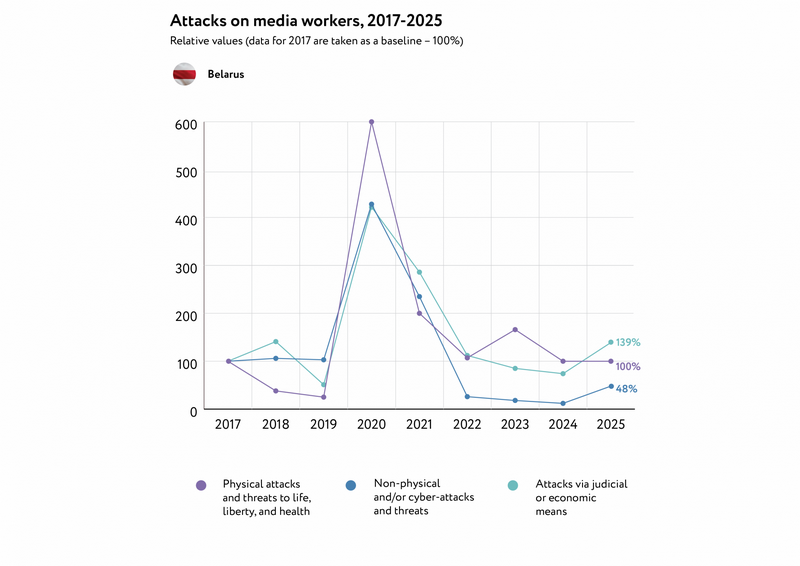
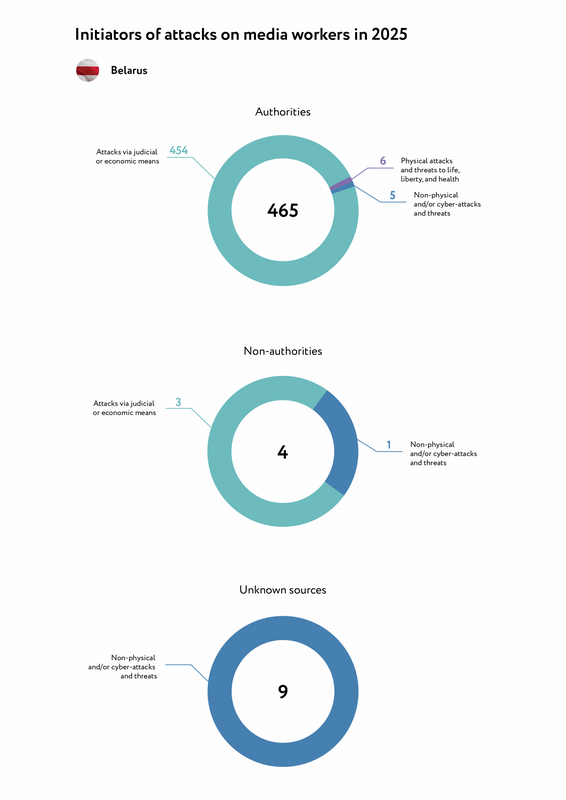
As in previous years, the main type of attacks against Belarusian media and their staff were those carried out through use of legal and/or economic mechanisms. They accounted for around 95% of all incidents. It should be noted that 465 of the 478 attacks originated from representatives of the authorities. In 2017–2020, the share of attacks involving legal or economic mechanisms stood at 83–85%; in 2021–2022 it ranged from 90% to 94%; and in 2023–2024 it reached 96%.
4/ PHYSICAL ATTACKS AND THREATS TO LIFE, LIBERTY AND HEALTH
The number of physical attacks and threats against journalists, which peaked during the 2020 protest period, has gradually decreased. In 2025, six physical attacks were recorded, the same number as in 2024. The decrease in physical attacks is the result of the forced emigration of most journalists from the country or their withdrawal from journalistic work due to direct threats to their safety. In all documented cases, the perpetrators of physical attacks were representatives of the authorities.
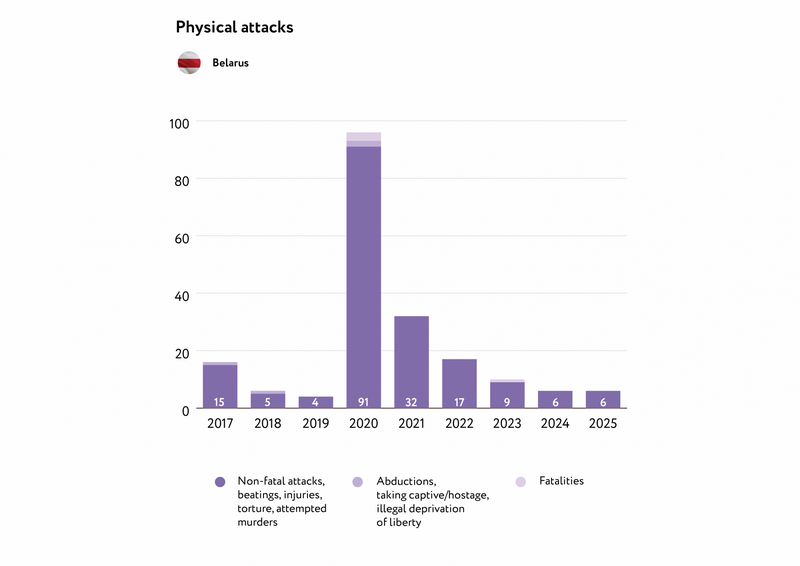
All recorded incidents were linked to media professionals serving criminal sentences (placement in punishment cells, denial of medical assistance, deprivation of the possibility to communicate with relatives and even with lawyers — a regime of incommunicado detention). However, the real number of such violations is significantly higher due to their latent nature and the impossibility of confirming them while political prisoners remain in places of detention. Some of these cases are:
- It became known that Belarusian journalist Dzianis Ivashin spent around two weeks in May 2025 in a punishment cell in Prison No. 8 in Žodzina.
- Imprisoned journalist Andrzej Poczobut has been repeatedly punished with solitary confinement and continuously held in a high-security cell. He is also denied phone calls and has not been allowed a single visit with relatives or received any parcels during his imprisonment.
- Vyacheslav (Vaclav) Oreshko, journalist and publicist, who was sentenced to eight years in prison, is experiencing serious health problems while in detention. He has nearly gone blind and, according to a former inmate of the colony, “can barely see beyond the length of his own arm.”
5/ NON-PHYSICAL AND/OR CYBER-ATTACKS AND THREATS
In 2025, 15 non-physical and/or cyber-attacks and threats were recorded. The violations included severe DDoS attacks on the websites of Nasha Niva, Zerkalo, and the Belarusian Association of Journalists, as well as large‑scale bot attacks targeting independent media resources. The hacking of the Telegram chatbot of the project Belaruski Hajun (an OSINT monitoring initiative that tracked the military activity of Russian and Belarusian forces in Belarus) led to the project’s closure and to criminal prosecution of a large number of Belarusians who had provided it with information. The exact number of people prosecuted in the Belaruski Hajun case is unknown; human rights defenders estimate around 160–170 confirmed defendants in criminal cases, though the real number may be higher.
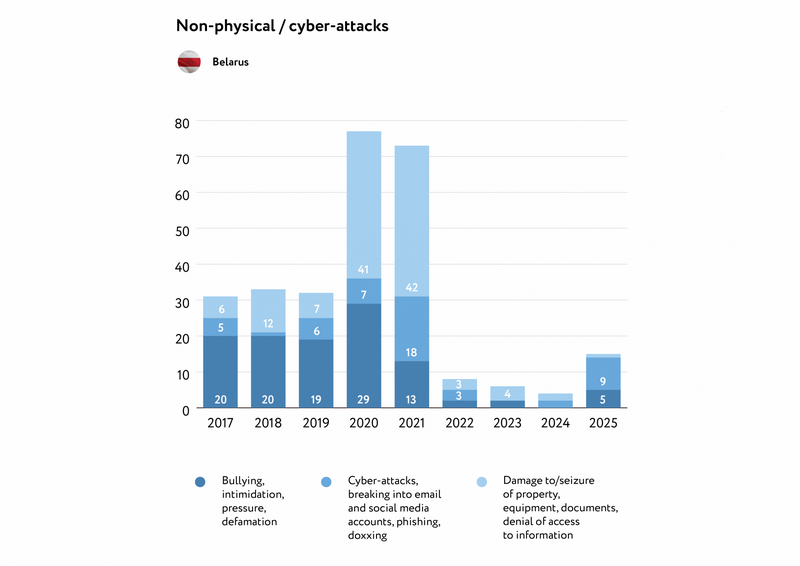
Other types of attacks included pressure on the relatives of journalists who had left the country, damage of property, the creation of fake accounts, and the dissemination of disinformation. In roughly one‑third of cases, such attacks were carried out by representatives of the authorities, but in most cases the perpetrators remained unidentified.
On 17 December, Reporters Without Borders’s Digital Security Lab has uncovered a previously unknown spyware tool used by the State Security Committee (KGB) of Belarus to target, among others, journalists and media workers. RSF assesses that this exposure is a serious setback for the KGB’s operations, not least because the software appears to have been in use for several years.
6/ ATTACKS VIA JUDICIAL AND/OR ECONOMIC MEANS
The main type of attacks against Belarusian media and their staff in 2025, as in previous years, were attacks with the use of judicial and/or economic means. They accounted for around 95% of all incidents. It should be noted that 465 of the 478 attacks originated from representatives of the authorities. Among the main types of attacks are criminal and administrative cases and inclusion into the registry of “extremist” materials (226 incidents) and interrogations, searchers, confiscations and court trials (169 incidents).
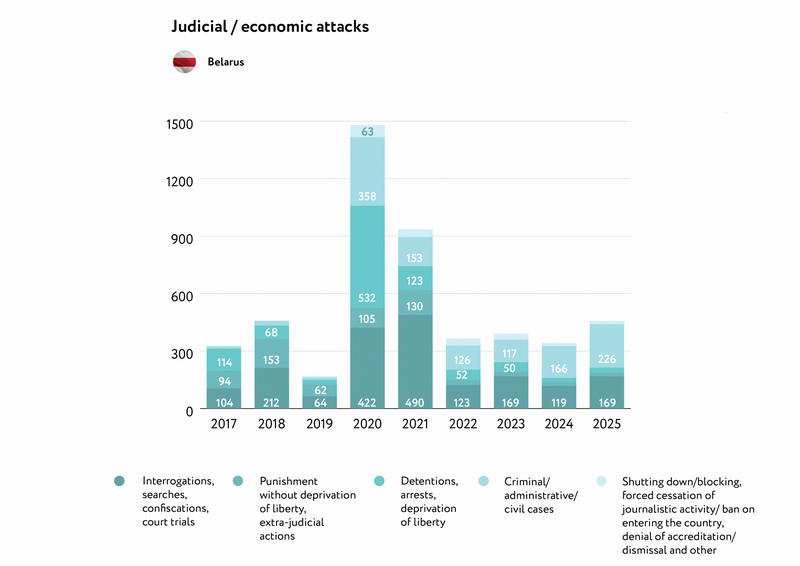
In 2025, the authorities continued to actively use anti‑extremism legislation to suppress freedom of expression. The designation of Belarusian media projects as “extremist formations” continued. As previously, the Ministry of Information continued to add a larger number of social media accounts of media projects and media workers to the Republican List of Extremist Materials. According to Viasna, in 2025, courts declared 2,107 pieces of informational content “extremist” — ranging from Telegram channels and TikTok accounts to books, websites of international organisations, and even a page listing political prisoners. The Republican List of Extremist Materials expanded to 1,928 pages and 8,172 entries.
Several media workers have been sentenced over the past year. Among these cases are:
- On July 25, freelance journalist Daniil Palianski was found guilty under Article 356 of the Criminal Code (treason to the state) and sentenced to 10 years of imprisonment and a fine of 21,000 rubles (5,500 EUR).
- On August 8, journalist Aleh Suprunyuk received a three-year prison sentence. He was convicted of involvement in an “extremist formation” (Article 361–1 of the Criminal Code). Prior to the verdict, he had spent over six months in pre-trial detention.
- On 16 September, Ihar Ilyash was sentenced to four years in prison and fined 4,200 rubles (1,050 EUR) on charges of discrediting the Republic of Belarus (Article 369 of the Criminal Code ) and facilitating extremist activities (Part 2 of Article 361 of the Criminal Code).
- On 5 October, videoblogger Karolina Kononovich reported that she had been sentenced to two and a half years’ imprisonment under Article 342 of the Criminal Code (active participation in actions that grossly violate public order). She was detained upon arrival in Minsk from Amsterdam and spent four months in pre‑trial detention. After the verdict was delivered, she left Belarus.
- On October 31, the Hrodna Regional Court sentenced Siarhei Chabotska under Article 361–1 of the Criminal Code (creation of an extremist formation). The editor was sentenced to three years and six months in a medium-security penal colony and fined.
- Blogger Polina Zyl was sentenced to one year in a general-security penal colony. She was detained in February and charged with organisation and preparation of actions that grossly violate public order, or active participation in them (Article 342 of the Criminal Code).
- Blogger Maksim Shukanau was sentenced to four years in a penal colony. He was charged with organisation and preparation of actions that grossly violate public order, or active participation in them (Art. 342 of the Criminal Code); creation of an extremist formation, or participation in it (Art. 361‑1 of the Criminal Code); and promoting extremist activities (Art. 361‑4 of the Criminal Code). Maksim had over 6,000 subscribers to his YouTube channel Union Bell.
- Journalist Palina Pitkevich was charged with participation in an “extremist formation” (under Part 3 of Article 361–1 of the Criminal Code) and sentenced Palina to three years in a general-security penal colony.
The exiled media workers were further criminally prosecuted in absentia in Belarus:
- On May 2, Siarhei Biaspalau, a blogger and the founder of ‘My Country Belarus’ Telegram channel was sentenced in absentia to 18 years in prison and a fine under several articles of the Criminal Code. Among other, he was criminally charged for the alleged ‘conspiracy to seize power in the unconstitutional way’ (article 357), ‘arrangement of riots, which were accompanied with violence, pogroms, arson, destruction of property and military resistance to governmental officials’ (article 293) as well as ‘insults and slander against the president of Belarus’ (articles 367 and 368).
- On June 3, blogger Anton Motolko was sentenced in absentia to 20 years in prison for treason, organising mass riots, calling for the seizure of power, discrediting Belarus, insulting and slandering Alyaksandr Lukashenka and other articles (13 in total).
ANNEX 1: OPEN SOURCES USED FOR GATHERING DATA (BELARUS)
- Article 19 – an international human rights organisation that works to defend and promote freedom of expression and freedom of information worldwide.
- Belarusian Association of Journalists – the largest democratic non-governmental association of Belarusian media representatives, a member of the International and European Federation of Journalists.
- Ministry of Information of the Republic of Belarus –a national government agency in the field of mass media that has serious administrative and sanction powers (from registering mass media to initiating their closure, as well as extrajudicial blocking of Internet resources).
- Belsat – a Polish free-to-air satellite television channel aimed at Belarus.
- Belta – a state news agency created to disseminate information about the activities of the state bodies of Belarus.
- Pozirk – a Belarusian news agency launched by journalists who had worked for BelaPAN and Naviny.by.
- Reporters Without Borders – an international non-profit and non-governmental organization that safeguards the right to freedom of information.
- Zerkalo – a Belarusian information portal.
- Viasna Human Rights Centre – a non-governmental human rights organization, created in 1996 during mass protest actions of the democratic opposition in Belarus.
- Belarusian and English-language resources that are available online.


 @bajmedia
Journalist Pavel Dabravolski sentenced to 9 years in prison
09.03.2026
Radio host and musician Aleh Khamenka sentenced to 3 years in prison
05.03.2026
Viktar Marchuk: “Digital technology can replace paper, but nothing can replace trust.”
03.11.2025
Roskomnadzor tries to block Novy Chas website, outlet responds with new mirror
20.05.2025