Andrzej Poczobut honored with the Sakharov Prize at European Parliament
 17 December 2025
A formal ceremony honoring the recipients of the Andrei Sakharov Prize for Freedom of Thought took place on December 16 in Strasbourg during a plenary session of the European Parliament. This year’s award was granted to Belarusian political prisoner and journalist Andrzej Poczobut and Georgian journalist Mzia Amaglobeli.
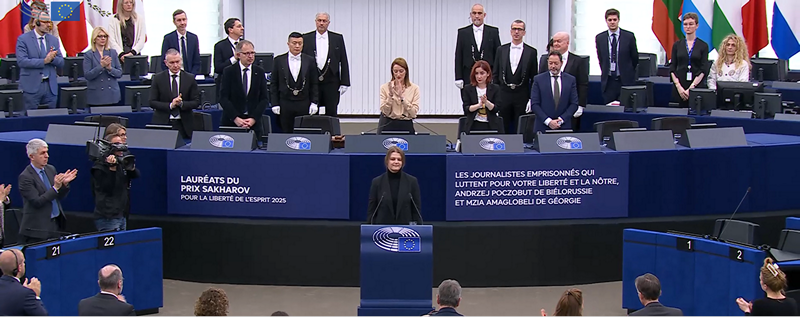
Andrzej Poczobut’s daughter, Yana, at the European Parliament. Video screenshot
Neither laureate was able to attend the ceremony in person, as both remain imprisoned in their home countries.
“We know how much these values are worth”
Opening the ceremony, Roberta Metsola, President of the European Parliament, emphasized that European democracy is built on freedom of thought and freedom of expression.
“We know how much these values are worth, and we will never surrender them.”
Metsola stressed that free and independent media are a cornerstone of democracy, noting the symbolic importance of awarding the Sakharov Prize to two journalists who have risked everything to expose threats to democratic values in their countries.
“But democracy cannot be silenced, and although they cannot be with us today, Andrzej and Mzia’s urgent calls for democracy ring clear in this chamber and across our continent. This house stands in solidarity with Andrzej and Mzia in their struggle. We call for their immediate release, along with every person wrongfully imprisoned.”
She added that the Parliament would continue to exert pressure until all political prisoners are free and reaffirmed Europe’s commitment to Belarusian society:
“We will keep up the pressure until everyone is free. We will not forget them. We will never abandon them, until the age of dictators is finally over, until Belarus is finally free. This Parliament sees what is happening in Belarus and in Georgia.”
“You can rely on this house to continue speaking up for Andrzej, for Mzia, and for all those who long for freedom,” stated Ms Metsola.
“Behind every name there is a home, a story, and people who are waiting”
During the ceremony, Yana Poczobut, the daughter of Andrzej Poczobut, addressed Members of the European Parliament. She reminded them that her family has lived in silence and uncertainty for nearly five years.
“Behind every name written in reports, there is a home, a story, and people who wait. My father is not only a public figure. He is a husband, a son, a friend. Every day of these five years, we have not known how he is, if he is safe. Yet every day we choose hope, because hope is the only thing that has not been taken from us.”
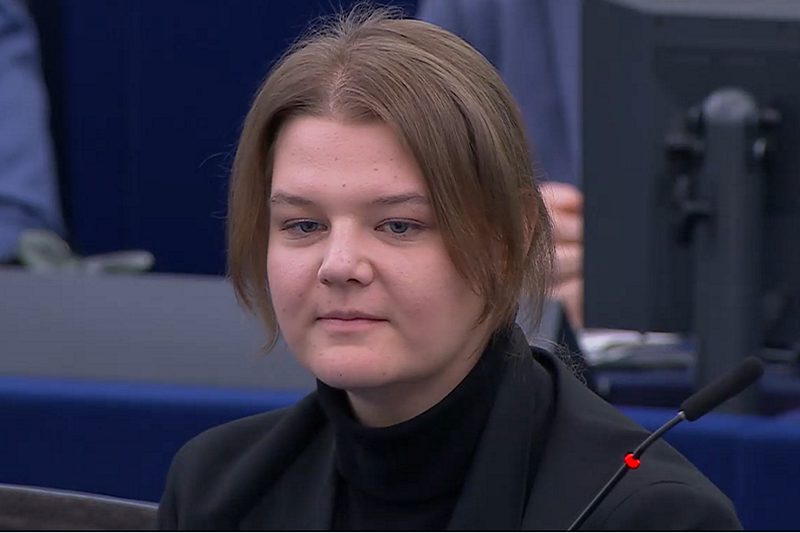
Andrzej Poczobut’s daughter, Yana, at the European Parliament. Video screenshot.
Yana Poczobut stressed that her family’s experience is far from unique. She mentioned the case of Belarusian political prisoner Mikalai Statkevich, who has been held incommunicado for years.
“I mention his name today not as a political statement, but as a reminder that behind every silence there is a human life and a family that deserve to know the truth. When we speak these names aloud, they stop being statistics. They become real again.”
She also addressed Mzia Amaglobeli directly, despite her absence:
“Mzia, although you cannot be here today because you are currently imprisoned, your bravery reached this room. Your dignity, your commitment, and your strength inspire far beyond the walls around you.
Your story reminds us that the struggle for human rights is universal. It does not belong to one country. And I stand in this hall, I think of families across different nations who live in uncertainty or separations, families who wait for news that never comes, families who try to hold on to hope even when they feel it’s slipping away.
My own family has been changed forever. The absence of my father is something we learned to live with but never to accept. (…) And although he cannot see this whole today, I hope he some somehow knows he is not forgotten.”
Her speech was met with a standing ovation.
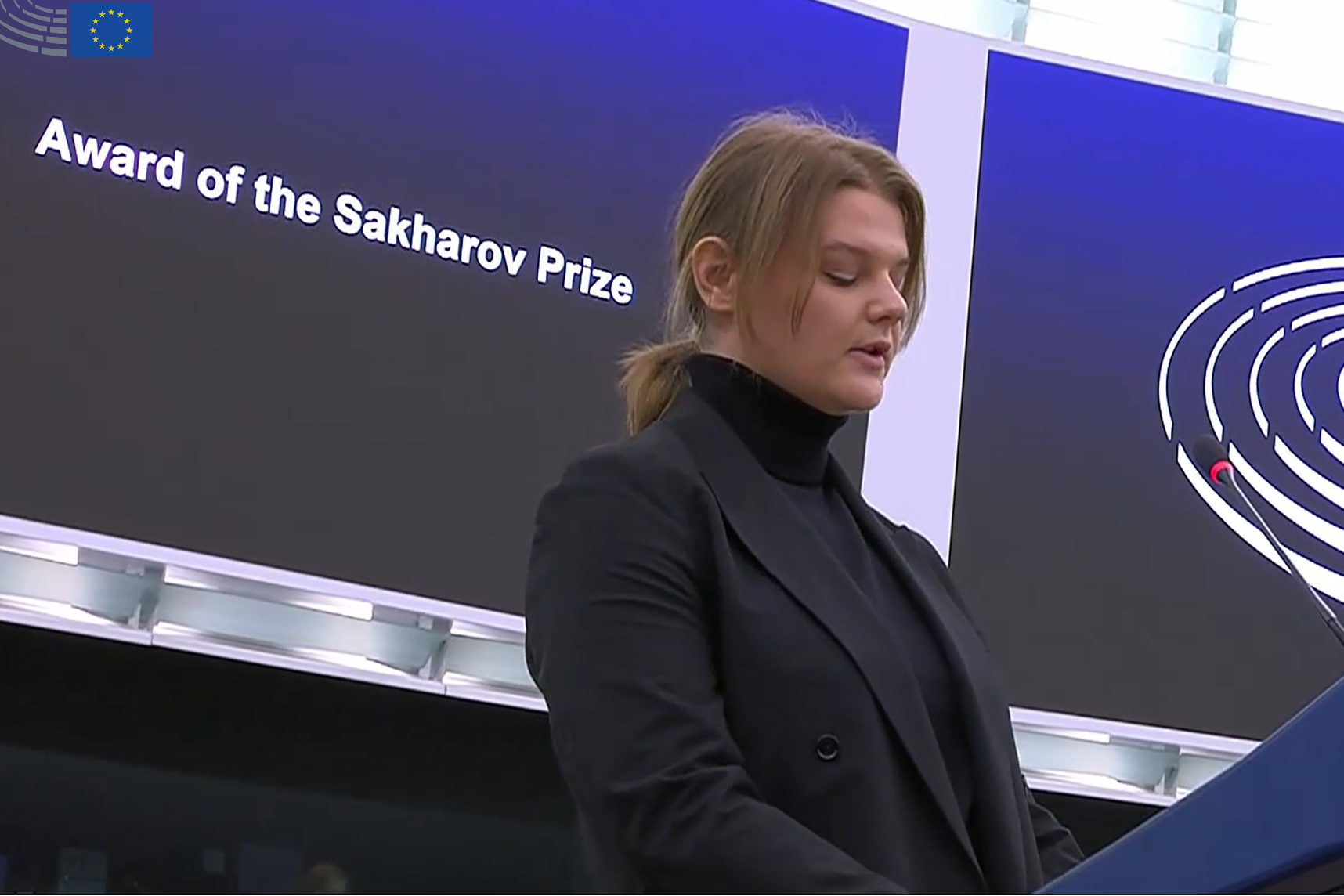
Andrzej Poczobut’s daughter, Yana, at the European Parliament. Video screenshot
The Sakharov Prize and Belarus
The Sakharov Prize for Freedom of Thought was established by the European Parliament in 1988 and is named after Andrei Sakharov, a Soviet physicist, dissident, and former political prisoner. It is awarded annually to individuals or organizations who have made an exceptional contribution to the defense of human rights and fundamental freedoms.
Belarus has a long history connected to the prize. Previous laureates include the Belarusian Association of Journalists (2004), opposition leader Aliaksandr Milinkevich (2006), and a broad group of Belarusian democratic leaders and activists in 2020, including Sviatlana Tsikhanouskaya, Sviatlana Aleievich, Maria Kalesnikava, Siarhei Tsikhanouski, Ales Bialiatski, and Mikalai Statkevich.

Mzia Amaglobeli from Georgia and Andrzej Poczobut from Belarus, 2025 Sakharov Prize laureates © L.S/Belta AFP & Z.T/Netgazeti
The Case of Andrzej Poczobut
Andrzej Poczobut was nominated for the Andrei Sakharov Prize by the European Conservatives and Reformists Group, which includes Poland’s Law and Justice party.
Andrzej Poczobut, a journalist and one of the leaders of the unrecognized Union of Poles in Belarus, was detained on March 25, 2021, in Hrodna as part of the so-called “Polish case,” which targeted activists of the Polish minority.
Belarusian authorities accused him of calling for actions allegedly harmful to national security and of inciting ethnic and social hatred. On February 8, 2023, a Belarusian court sentenced Poczobut to eight years in prison.
The Belarusian Association of Journalists strongly condemned the verdict, describing it as politically motivated. Today, Andrzej Poczobut is one of 28 imprisoned media workers in Belarus, symbolizing the broader crackdown on independent journalism under the Lukashenka regime.
The Case of Mzia Amaglobeli
Georgian journalist Mzia Amaglobeli, founder of the outlet Batumelebi, was arrested on January 11, 2025, during the government’s crackdown on pro-democracy protests. She was initially accused of assaulting a police officer following a confrontation with the Batumi police chief.
Despite international criticism, Amaglobeli was convicted of resisting and threatening a law enforcement officer and sentenced to two years in prison. Human rights organizations, including the Belarusian Association of Journalists, had called for her immediate release and the dropping of all charges.
The 2025 Sakharov Prize once again underscores that repression in Belarus remains one of Europe’s most urgent human rights crises, and that the fate of political prisoners like Andrzej Poczobut continues to demand international attention and pressure.


 @bajmedia
Editor of s13, Siarhei Chabotska, added to Belarusian “extremist” list
24.11.2025
Aliaksandr Klaskouski: Fundraising for Repatriation and Funeral Costs
11.06.2025
Roskomnadzor tries to block Novy Chas website, outlet responds with new mirror
20.05.2025
Dzianis Ivashyn describes spending Christmas behind bars
09.01.2026