Ales Bialiatski creates a foundation to fight the global human rights crisis
 11 June 2026
After his release and forced deportation from Belarus, Ales Bialiatski, chairman of the Human Rights Center Viasna and winner of the 2022 Nobel Peace Prize, announced the creation of The Ales Bialiatski Foundation. The new organization will work at the strategic intersection of human rights, peacemaking, and regional security, strengthening the global human rights alliance in an unprecedented geopolitical crisis.
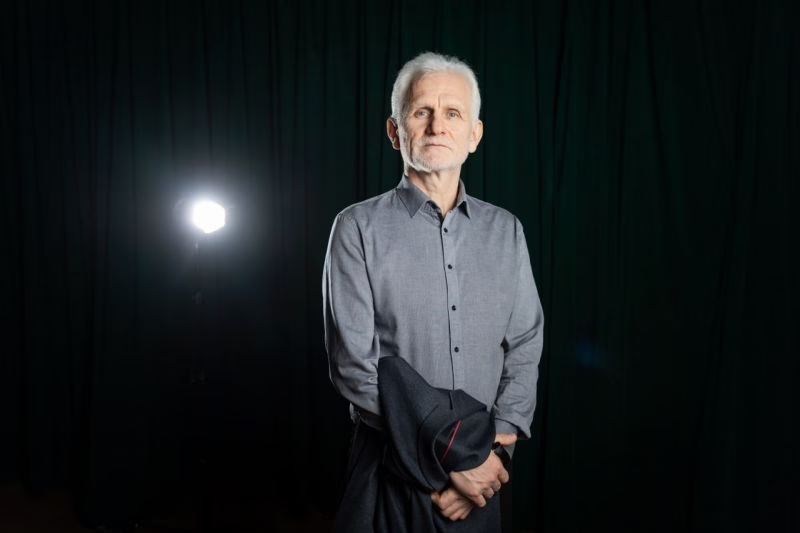
Photo: Stina Stjernkvist/Right Livelihood Foundation
Responding to the global human rights crisis
Today, the region of Eastern Europe, the South Caucasus, and Central Asia is facing a deep crisis: a full-scale war has returned to Europe; Ukraine is fighting for survival; and the space for civil society inside Belarus and Russia has been completely destroyed. This trend holds true in an increasing number of countries: the situation in Kyrgyzstan and Georgia is causing increasing concern. Activists, journalists, and lawyers everywhere face repression, prison, and exile.
However, the founders of the Foundation emphasize that the crisis is not only regional, but also global. Polarization and anti-rights narratives are eroding the universality of law around the world, which requires fundamentally new leadership and strategies.
Why create the Foundation now?
The founder of the organization, Ales Bialiatski, explains the grounds for its emergence:
“When I was released at the end of 2025, I saw a reshaped world filled with deep global uncertainty. In the first months at liberty, I consulted with colleagues from the Human Rights Center Viasna, Nobel Peace Prize laureates, dozens of civil society leaders, and diplomats. I met with the UN High Commissioner for Human Rights and a number of heads of state. I have talked to long-time colleagues working in human rights from all over the world. These conversations confirmed the need to create new forms of cooperation and moral leadership. That is why I have created a new organization in Poland. I will devote my time, my energy, my network of contacts, and part of the funds received from the Nobel Prize to it.”
What will the new organization do?
The new organization will focus on strategic and global challenges and tasks, and its activities will be based on the intersection of five key areas: human rights, peacemaking, international justice, the sustainability of civil society, and the human dimension of regional security.
The organization will actively defend principled and consistent approaches to international human rights mechanisms, as well as promptly respond to systemic and existential threats to international law. Its important priorities include promoting innovative models of global accountability and human rights protection, as well as countering the growing threat of transnational repression.
The Foundation plans to pay special attention to the development of intergenerational dialogue and support for international youth and civic leadership. Through a system of special scholarships, mentoring, and the Ales Bialiatski Youth Award, the organization will provide new leaders with the necessary skills and international networks to work effectively even in the face of a geopolitical crisis. At the same time, Ales Bialiatski’s constant priority remains the support of a free and sovereign Belarus.
“We hope that this will allow us to effectively promote a universal approach to human rights”
Ales Bialiatski invited Sasha Kulayeva (France), an expert with experience in senior positions in non-governmental international organizations, a lecturer in human rights and international relations at international universities, author of numerous human rights studies, and a long-time partner of Viasna, to become the head of strategic development, advocacy, and partnerships.
“Ales Bialiatski’s work and personality are well known in the international arena, as well as his long-term struggle for human dignity in the face of brutal repression, and not only in Belarus. Ales went on working trips to various countries of the world, for example, to Egypt and Morocco, to revolutionary Tunisia in 2011, to Cuba to support Cuban dissidents, and to South Africa. He is known in Asia, Latin America, and the Middle East, let alone in Eastern Europe and Central Asia. His voice has exceptional authority among governments, international organizations, and civil society. Our first meetings showed that the new Foundation already has a high level of trust and global support. We hope that this will allow us, together with our colleagues, to effectively promote a universal approach to human rights and fight against the polarization that threatens the institutions and mechanisms of international law, which have been arduously created over the years,” the expert notes.
“Today, the scale of the crisis requires a different contribution from me”
Ales Bialiatski emphasizes that he remains the chairman of Viasna, but his personal focus has moved to the international space:
“Behind bars, I learned the full extent of what happened after my arrest: more than 30 activists of Viasna and their relatives were detained, and 120 searches and more than 200 interrogations were conducted. However, I was deeply impressed when I found out that the structures we had created had not broken down. Viasna managed to leave Belarus, evacuate its members, and resume its activities abroad. Today, it continues its mission with international recognition and support.
For thirty years, with the exception of the time I spent in prison, I was the head of Viasna. In recent years, I have mainly focused on strategy, analysis, global education, and international activities. Together with my colleagues from Viasna, I continue this important work for Belarus.
But today, the scale of the crisis requires a different contribution from me. I believe that I should work more internationally, using the moral capital of the Nobel Peace Prize, the international experience gained over the years as Vice President of the International Federation for Human Rights, my membership in the International PEN, as well as the experience gained over decades of struggle against dictatorship and political repression.
As a member of the global community, I feel a responsibility to defend the universality of human rights at a time when this very concept is under threat.”


 @bajmedia
Five journalists among those released on September 16
16.09.2026
Imprisoned videographer Yauhen Hlushkou released upon completing his sentence
24.08.2026
Belarus adds more independent journalists to interstate wanted lists
14.08.2026
European Journalists’ Soccer Tournament Opens With Minute of Silence for Mikita Melkaziorau
14.09.2026