Journalist Dzianis Ivashyn transferred back to Mahilou Correctional Facility No. 15
 30 June 2026
Journalist Dzianis Ivashyn, who is serving a 13-year prison sentence, had spent the previous three years in the high-security prison in Zhodzina. Following his transfer back to the correctional facility, his relatives received an official notice regarding his possible parole eligibility — after February 13, 2030.
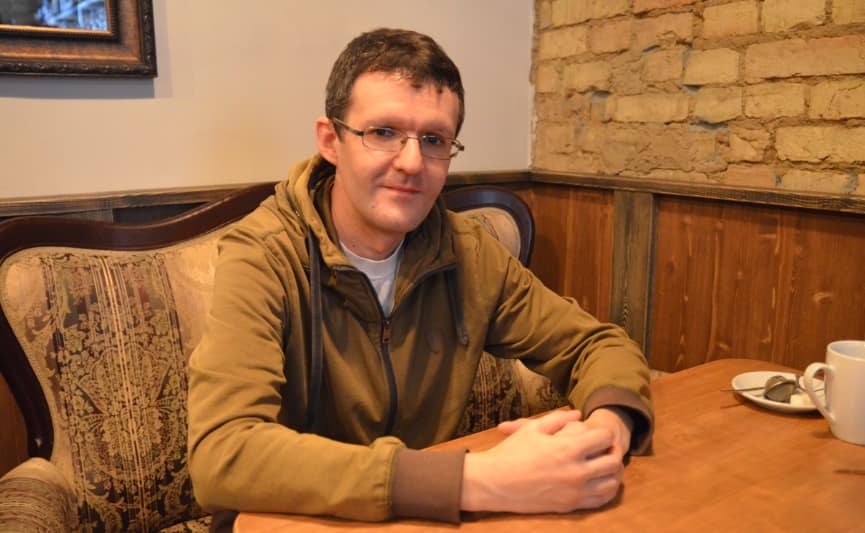
Dzianis Ivashyn. Photo: from personal archive
Relatives have now received his first letters from the correctional facility. A letter to his mother dated June 18 indicates that Dzianis was in a quarantine unit at that time, the journalist’s wife, Volha Ivashyna, reported on Facebook. A postcard from her husband reached her a few days later as well.
Volha says she is concerned by a line in the letter in which he writes that he has not yet resumed exercising and is “operating in energy-saving mode.”
According to her, the transfer back to the Mahilou correctional facility — where Dzianis was originally sent to serve his sentence — can hardly be regarded as a relief compared to the prison where the journalist served the past three years.
“For Dzianis, the Mahilou facility is actually worse than the prison in Zhodzina. On orders from the facility’s leadership, he was beaten there, and then isolated from other prisoners in a punishment cell so no one would see his bruises. As his transfer to the prison approached, he was thrown into punishment cells and secure housing unit almost continuously. He was mistreated for speaking and writing letters in Belarusian; his letters were destroyed, and he was denied phone calls, food parcels, and visits with his parents. And all this happened within just a few months at the facility — he wasn’t even there for half a year,” Volha Ivashyna said.
According to Volha, the journalist’s mother recently received an official letter from the correctional facility administration stating that the prisoner Dzianis Ivashyn had arrived there on June 18, 2026, and that he would become eligible for parole after February 13, 2030. To qualify, however, he must “prove his own reform” through his conduct.
The letter, signed by the head of the facility’s special department, surnamed Mastsepanenka, also states that after January 9, 2029, Dzianis Ivashyn may become eligible for a commutation of his sentence to a more lenient form of punishment. This likewise requires him to demonstrate to the facility administration that he has “firmly set out on the path of reform.” Also required are a written pledge of “law-abiding conduct,” an absence of disciplinary sanctions, a conscientious attitude toward work, and maximum compensation for “the harm caused by the crime.”
In connection with the latter point, relatives have been encouraged to help compensate for this harm and to “exert a positive influence” on the prisoner. According to the journalist’s wife, the material damages set by the court were paid off long ago.
“We were hoping Dzianis might be exchanged for some prisoners of war or spies, so we decided to pay everything off to make sure that was in order — and so the facility administration wouldn’t have any additional leverage to pressure Dzianis. As for the notice from the correctional facility, it’s a standard form letter sent to everyone. It lists, for instance, the permitted limits for prisoners on the number of care packages, visits, and so on. But, for example, during Dzianis’s first stint at this facility, his commissary allowance was immediately cut to $16, even though high security level allows for twice as much. In reality, it’s all decided by the administration,” says Volha Ivashyna.
The case of Dzianis Ivashyn
Dzianis Ivashyn is a correspondent for the independent Belarusian newspaper Novy Chas and a volunteer editor of the Belarusian-language version of the website run by InformNapalm, an international investigative community. The journalist is known for his investigations into the influence of the “Russian world” on Belarus and Syria, as well as into the controversial development of the Kurapaty memorial site near Minsk.
Dzianis Ivashyn has been imprisoned for nearly five years, since March 12, 2021. He was initially charged with interference with the activities of internal affairs officers, and authorities later added a charge of “high treason” as well.
The “last straw” for the Belarusian authorities was likely his investigation into former Ukrainian security officials who had taken jobs with the Belarusian riot police. The journalist was detained literally the day after he gave an interview about this to the independent TV Current Time.
On September 14, 2022, the Hrodna Regional Court found him guilty of treason and illegal collection and dissemination of information about private life. Judge Valer Ramanouski sentenced Ivashyn to 13 years and 1 month in prison. He was also ordered to pay a total of $9,030 in moral damages to nine security officers.
In late June 2023, his punishment was tightened: without notifying his family or lawyer, the court transferred him to a high-security prison.


 @bajmedia