Mass media in Belarus 2025
 2 April 2026
Mass media in Belarus 2025. Download PDF.
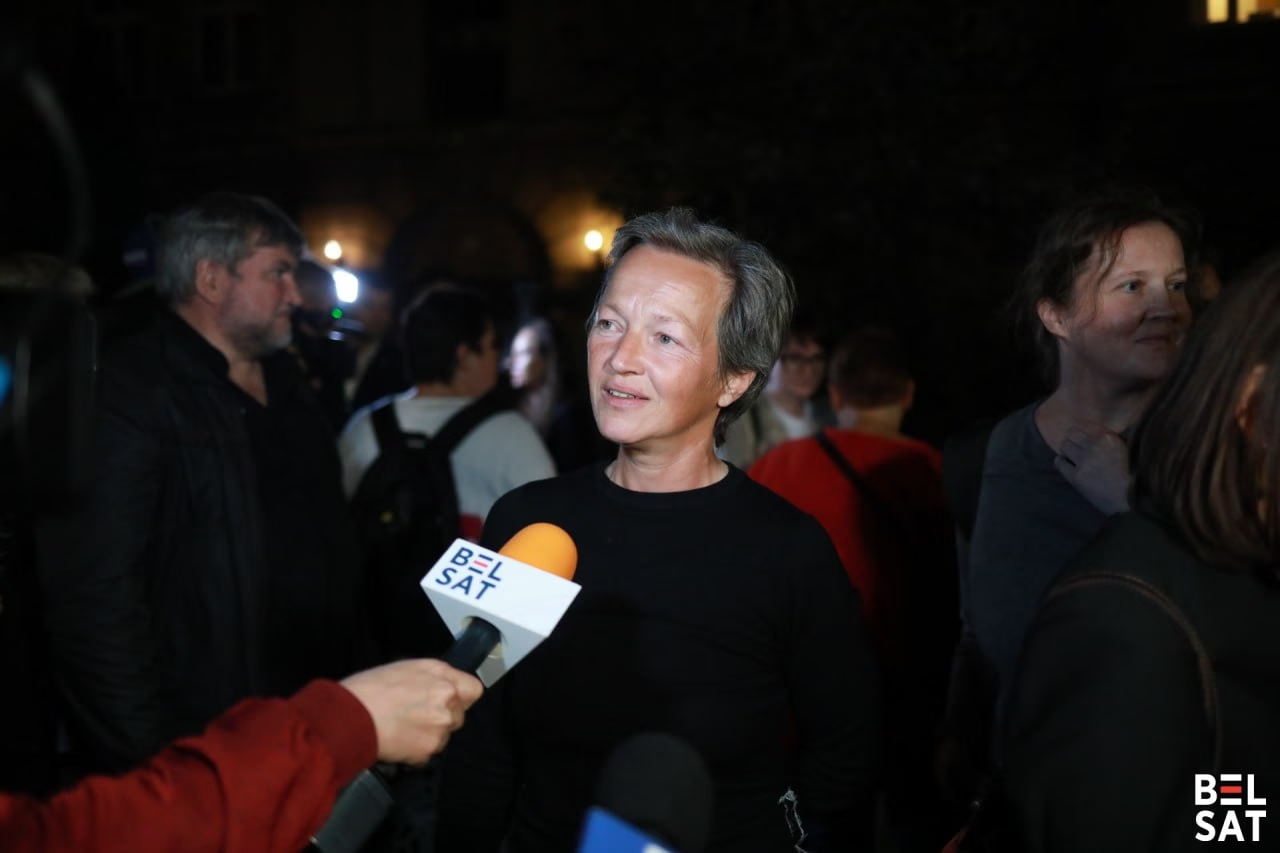
Iryna Slaunikava after her release. Vilnius, September 11, 2025. Photo: Belsat
Conditions for independent media sector activity in 2025
The Belarus government continued systematic persecution of the independent press within the overall context of its fight against dissent in 2025. The pressure on media workers intensified on the eve of Aliaksandr Lukashenka’s election on January 26, 2025 as well as in April 2025, when the few still operating independent regional media outlets suffered from searches and crackdowns in the governmental propaganda channels.
Criminal prosecution of Belarusian independent journalists and bloggers in Belarus and abroad as well as pressure and harassment in relation to them continued within the period under review.
At least 10 criminal convictions were pronounced to journalists in 2025. The harshest sentence of 10 years in prison was handed down to Daniil Palianski. Criminal charges in absentia against Belarusian journalists living abroad became widespread in 2025 with over 100 filed cases during the year. The Belarus authorities exerted pressure on the forcibly exiled media workers through their relatives in Belarus.
A Belarusian journalist faced an incident of gender-based violence online during a live broadcast. Public actions of this kind threaten the peace and safety of independent female journalists in general.
As before, the so-called ‘fight against extremism’ was widely used to restrict freedom of expression and access to unofficial sources of information. Thus, independent media projects were further designated as ‘extremist groups,’ and large-scale prosecution for any form of interaction with ‘extremist’ content continued in the country.
The manifestation of censorship intensified at the state level. It went beyond ‘countering extremism’ and extended to non-political topics. The number of online media resources, which were blocked in the first five months of 2025 equaled to the number of 3,150 blocked media resources in the whole year of 2024. It was for the first time that the Belarusian Web-users’ access to Tik Tok was blocked. At least for the first time, access to TikTok for Belarusian users was blocked. In particular, the Belarusian authorities blocked access to the accounts of opposition leaders Sviatlana Tsikhanouskaya and Pavel Latushka.
The practice of direct intervention by security agencies in the dissemination of information and communications was institutionalized in 2025. Thus, the KGB, the Ministry of Internal Affairs, the Investigative Committee, and the Prosecutor General’s Office were given the authority to block websites and disconnect users from communications. Previously, the Internet regulation was implemented by the Ministry of Information. And it was carried out primarily with the use of administrative measures.
The pressure exerted by the Belarusian authorities on exiled media outlets and the difficulties associated with relocation are exacerbated by economic problems, including a critical decline in advertising revenue, sales, and other income streams, on the one hand, and the simultaneously increasing expenses, on the other hand. The problem has sharply increased since the beginning of 2025, due to the reduction in the US financial support for media projects around the world.
None of non-state socio-political periodical editions that offer their readers alternative viewpoints to the official ones survived in Belarus by the end of 2025. Alongside with the independent regional media outlets that were effectively destroyed as a result of the governmental repressions, some other non-state regional newspapers seized their existence in 2025. Thus, the ‘Viacherni Mahilou’ newspaper terminated its operation in Belarus. It was founded in 1992. After 2013, the periodical became notorious for its homophobic and anti-Semitic articles, which were regularly published under Nadzeya Leuchanka’s editorship). Another regional newspaper, ‘Homan Barysaushchyny’, that covered events in the city of Barysau (Minsk region) and the surrounding district since 1996 was closed down in 2025, too.
The Ministry of Information intensified its efforts, aimed at identifying and banning the distribution of unwanted books, ‘which could harm the national interests of the Republic of Belarus.’ 190 books were added to the list during the year of 2025. This trend demonstrates the desire of authorities to limit the dissemination of ideas that differ from official ideological guidelines, including those concerning gender diversity and non-traditional models of relationships.
Propaganda and discreditation of opponents remained an integral part of governmental policy in the media field. New provisions ‘On the Ministry of Information’ were adopted on September 16, 2025. They formally enshrined the propaganda functions of this government agency. The outcome of a research study on pro-government propagandists’ activities indicate the presence of a “digital authoritarian trend” that means an oversaturation of the media space with controlled narratives.
Belarus ranked 166th in the 2025 World Press Freedom Index, published by the Reporters Without Borders non-governmental organization, moving one position upwards since the previous year. At the same time, the position of Belarus in the Freedom on the Net 2025 rating list, published by Freedom House, further deteriorated, with a score of just 20 out of 100 (compared to the score of 22 a year before). Thus, Belarus confirmed its status of a country with the unfree internet.
28 media representatives remained behind bars as of December 31, 2025 (to be compared to 45 media workers a year before).
A freelance journalist Daniil Palianski was convicted of ‘high treason’ (Article 356 of the Belarus Criminal Code) in a closed trial and sentenced to 10 years of imprisonment.
The list of imprisoned media workers includes an investigative journalist Dzianis Ivashyn, sentenced to 13 years in prison for ‘high treason’, one of the TUT.by News Portal directors Liudmila Chekina, who is serving a 12-year sentence, and the editor of ‘The Belarusian Yearbook’ Valeryia Kastsiuhova, who was sentenced to 10 years in prison. Like all other political prisoners, the journalists were subjected to pressure and inhumane treatment in 2025.
In particular, it came to light that some political prisoners were subjected to severe pressure due to the attention of independent media to their personalities. This can be considered a specific form of censorship.
As a result of diplomatic efforts, taken by the US delegation led by the US President’s envoy John Cowell, 14 Belarusian journalists were released from prison throughout the year of 2025. The list of liberated media workers included Andrei Kuznechyk, Ihar Karnei, Deputy Chair of Belarusian Association of Journalists Iryna Slaunikava, Mikalai Dziadok, Pavel Mazheika, Aliaksandr Mantsevich, Larysa Shchyrakova, Yauhen Merkis, Alena Tsimashchuk, Viachaslau Lazarau, Pavel Padabed, Ihar Losik, Maryna Zolatava, Aliaksandr Fiaduta as well as bloggers Dzmitry Kazlou and Pavel Vinahradau.
It should be noted that most former political prisoners, including journalists, were sent out of Belarus without documents and deprived of the opportunity to choose their country of residence. They were effectively expelled from the territory of the Republic of Belarus. The release of Belarusian journalists was made possible due to the actions of international solidarity.
The activity of Belarusian independent media was carried out in the forced exile.
The Belarusian Association of Journalists approved the Strategy of its activities for 2025 – 2027 on September 15, 2025.
The strategy emphasizes the need for the organization and all independent media to return to Belarus and get their legal activity restored in the country. Also, it emphasizes the importance of Belarusian-language and national content for preserving the national identity of target audiences.
Changes in legislation
The Belarusian authorities introduced amendments to the Guidelines ‘On Registration of Domain Names in the National Domain Zone of Belarus’ on January 17, 2025. The innovations allow the administrator of the national domain zone to cancel the domains, which are ‘capable of harming the national interests of the Republic of Belarus,’ while simultaneously including them into a special ban list. The notion of causing harm to national interests was not specified anywhere at that.
On February 17, 2025, Aliaksandr Lukashenka signed Law No. 61–3 “On Amending the Codes on Criminal Liability Issues.” Overall, this legal act significantly softens the current criminal legislation. However, this humanization does not address “anti-extremism” and “anti-terrorism” articles, nor does it address provisions aimed at protecting government institutions and state symbols. These are the very provisions, which are typically used for political persecution that includes violations of freedom of expression.
The law expands the list of crimes for which Belarusian citizens or stateless persons permanently residing in Belarus are subject to criminal liability, even if these crimes were committed abroad and regardless of whether they are recognized as crimes in the country where they were committed.
In line with the adopted amendments, the list of articles of the Criminal Code with extraterritorial effect has been expanded. Among others, it includes:
- articles 130–130–2 of the Criminal Code (incitement of hatred, rehabilitation of Nazism, denial of the genocide of Belarusian people),
- ‘defamation’ articles 367–369–1 (slander and insult against government officials and the president, discreditation of the Republic of Belarus),
- article 370 (desecration of state symbols).
Obviously, these amendments formalize the practice of prosecuting pro-democracy opposition activists abroad for critical statements. This kind of repression was already implemented through criminal prosecution in absentia, i.e. the so-called “special proceedings” provided for by the Criminal Procedure Code, in the past. (They were introduced into the Criminal Procedure Code in 2022.)
However, the approved amendments may serve as additional legal grounds for the Belarusian authorities to prosecute individuals for committing certain undesirable actions abroad.
The law amends Article 367 of the Criminal Code (“Defamation of the President of the Republic of Belarus”) and Article 368 (“Insulting the President of the Republic of Belarus”), extending their application not only for defaming and/or insulting the current head of state, but also for committing such actions in relation to an individual who has ceased to perform the respective official duties.
On June 10, 2025, the Council of Ministers of Belarus approved Resolution No. 319 “On Amending the Belarus Council’s of Ministers Resolutions No.1256 of December 30, 2014 and No. 575 of October 12, 2021,” which changed the procedure of populating the lists of individuals and legal entities, associated with terrorist and extremist activity. The document was adopted at the initiative of the KGB, the Ministry of Internal Affairs, and the Prosecutor General’s Office in order ‘to clarify the legal basis and unify approaches in the field of countering terrorism and extremism.”
According to the Belarus Law ‘On Counteraction to Extremism’, the notion of ‘extremist activity’ exceeded the actions, which were directly specified in the law, by including additionally the crimes against public order, morality, governance, life and health, personal freedom, honor, dignity, and property, provided that they were considered to be ‘hate crimes’.
The Resolution of the Council of Ministers significantly broadens this approach. Thus, any articles of the Special Part of the Criminal Code (including economic and tax-related articles) can now be grounds for inclusion in the “list of individuals involved in extremist activity,” if the crime was committed on the grounds of racial, national, religious, political, ideological hostility, or hostility toward a social group.
Thus, a legal basis has been created for classifying virtually any actions that might be considered incompatible with government policy or associated with the expression of dissent as ‘extremist’ or ‘terrorist,’ further blurring the boundaries of the relevant legal categories.
On September 2, 2025, the Council of Ministers of Belarus approved Resolution No. 476 “On the Procedure for Applying Restrictive Measures.” The document establishes mechanisms for restricting access to Web-resources and terminating telecommunications and internet providing services. Under the new procedure, the KGB, the Ministry of Internal Affairs, the Investigative Committee, and the Prosecutor General’s Office have been granted the authority to block websites and disconnect users from communications.
Previously, it was only the Ministry of Information that had such authority. Nowadays, decisions to block access to Web-resources can be grounded both on the monitoring data and the outcome of an investigation or a criminal case. Restrictions on access to Web-resources can be introduced for the period of up to six months. If the identified legal violations are resolved, access to the respective Web-resources can be restored by a decision of the agency that initiated the blocking.
While the regulation of Internet space was the responsibility of the Ministry of Information, it was primarily administrative in nature. The transfer of these powers to the aforementioned government agencies institutionalized the practice of direct interference of law enforcement agencies in the dissemination of information and communications, effectively removing the barrier between criminal proceedings and the regulation of access to information.
On September 19, 2025, a new Regulation on the Ministry of Information of Belarus was approved. The list of main tasks of the Ministry was expanded to include ‘information support of ideological work in the Republic of Belarus, information support and facilitation of state policy in the field of mass media and publishing.”
A list of print media outlets to be funded from the National budget in 2026 was approved by Resolution No. 685 of the Council of Ministers dated November 28, 2025. 21 periodical editions were included in the list. The number of publications was the same as a year before. The ministerial authorities introduced only change to the list. The ‘Rodnaye Slova’ (‘Native Word’) monthly scholarly and methodological magazine for the teachers of Belarusian language and literature will be funded from the state budget in 2026 instead of the children’s ‘Viasiolka’ (‘Rainbow’) magazine, published in the Belarusian language.
The projected budget funding of state media was slightly increased (by 9.7%) in accordance with the Law of the Republic of Belarus “On the National Budget for 2026”, adopted on December 29, 2025,.
Violations of journalists’ and media rights
Criminal prosecution
The criminal prosecution of journalists continued in Belarus. It was targeted at the media workers residing in the country and in the forced exile.
The Belarusian judicial system handed down no less than 10 convictions in criminal cases against journalists and 6 verdicts against bloggers in 2025.
Ihar Ilyash, a journalist and husband of political prisoner and journalist Katsiaryna Andreyeva was put on trial in Minsk on February 21, 2025. He was sentenced to 4 years of imprisonment in a maximum-security colony and a fine of 4,200 Belarusian rubles for the alleged ‘discreditation of Belarus’ (article 369–1 of Belarus Criminal Code) and ‘facilitation of extremist activities’ (article 361–4 of Belarus Criminal Code) on September 16, 2025.
A journalist Palina Pitkevich was sentenced to three years of imprisonment in Minsk on March 7, 2025. She was accused of participation in an ‘extremist grouping,’ namely the ‘Media IQ’ online publication.
Volha Loika and Alena Talkachova, former employees of Tut.by News Portal were included in the list of ‘individuals involved in extremist activities’ on April 26, 2025. This means that court verdicts against them were pronounced in absentia and that the respective sentences came into force. Reportedly, the trial began on February 4, 2025. However, its details remain unknown, since the case hearing was held behind closed doors.
A freelance journalist from Brest Daniil Palianski was found guilty of ‘high treason’ (Article 356 of the Belarus Criminal Code) in a closed trial and sentenced to 10 years of imprisonment and a fine of about USD 7,135 on July 25, 2025. Due to the ‘confidentiality’ of the trial, the actual essence of the charges remains unknown.
Another journalist from Brest Aleh Suprunyuk was sentenced to 3 years in prison for the alleged ‘participation in an extremist grouping’ on August 8, 2025. He previously collaborated with a number of independent media. Despite the fact that the journalist has a disability, he was held in custody for more than six months before trial.
On October 31, 2025, Siarhei Chabotska, the editor of s13.ru Hrodna News Portal was sentenced to 3.5 years in a maximum-security penal colony for the alleged ‘extremism’ and ‘slander’ against Aliaksandr Lukashenka. (He had been held behind bars for over a year before the trial).
Reportedly, four employees of the BAR24 News Resource (Baranavichy, Brest region), which was created by the team of the Intex-Press former independent regional publication, labeled as ‘extremist’ by Belarusian authorities, were convicted under Article 361–4 of the Criminal Code of Belarus (‘promotion of extremist activity’). Accordingly, four employees of the Baranavichy-based News Resource Natallia Semianovich, Mikita Piatrousky, Ruslan Raviaka, and Liudmila Zeliankova were sentenced to restriction of liberty.
The Belarusian judicial authorities changed the sentence of former editor of “Novy Chas” newspaper Aksana Kolb on March 18, 2025. She was initially convicted of “arranging and preparing actions that grossly violate public order or actively participating in them” in 2022. Her restriction of liberty was replaced with 1 year and 33 days in a penal colony. Oksana Kolb herself is currently outside Belarus.
New criminal cases were filed and more journalists got detained in connection with criminal prosecution in 2025.
Reportedly, a journalist Pavel Dabravolski has been accused of ‘high treason’ under Article 356 of Belarus Criminal Code in connection with his professional activities. (He previously worked for both Belarusian and foreign media outlets, including the Ukrainian NV.ua magazine). The media worker has been behind bars in the KGB detention center since January 2025. He faces up to 15 years in prison.
The list of arrested media workers also included a journalist from Polatsk Tsina Palynskaya and her elder daughter Marharyta Rabinovich as well as Kiryl Pazniak and his daughter Yanina Pazniak. The latter were arrested on the day, when the ‘Platform 375’ YouTube channel was labeled by the Belarusian authorities as an ‘extremist grouping’.
The prosecution of Belarusian journalists living abroad in absentia for the alleged commitment of criminal offenses became widespread in 2025. The Belarusian Association of Journalists (BAJ) recorded over 100 cases of this type of persecution within the period under review.
The list of numerous affected individuals included the Belsat TV employees Volha Starastsina (the second criminal case) and Yaraslau Stseshyk. the former employees Siarhei Skulavets and Andrei Mialeshka as well as Iryna Khalip, who works as a special correspondent for ‘Novaya Gazeta Europe’. (The latter learned about the case from her parents in Minsk after a search of their apartment by law enforcement officers on November 27, 2025.)
Political analysts Aliaksandr Klaskouski, Piotr Rudkouski and Aliaksandr Fridman as well as journalists Tatsiana Karaviankova, Glafira Zhuk and Tatsiana Ashurkevich were put on the Belarus / Russia interstate wanted list in 2025. The media workers were classified by the Belarus Ministry of Internal Affairs as members of ‘Pozirk’ News Agency, labeled as an ‘extremist grouping.’
Bloggers were similarly prosecuted on criminal charges.
On January 28, 2025, the apartment of blogger Vadimati (Vadim Yermashuk) was searched and arrested in Hrodna in connection with the initiation of a new criminal case. The former political prisoner fled Belarus after serving a prison term. Reportedly, he was put on the wanted list in connection with new charges under Articles 361–4 (‘assistance to extremist activity’), 369 (‘insulting a government official’) and 391 (‘insulting a judge’) of Belarus Criminal Code.
On January 29, 2025, the Homiel Regional Court sentenced a well-known blogger Victoryia Husarava (“gusarev_ka”) to the restriction of liberty without sending her to an open correctional facility (“home confinement”). The blogger has more than 32,000 followers on Instagram and more than 17,000 followers on TikTok. It is known that she was charged under Article 130 of the Criminal Code (‘incitement to social hatred or hostility’). However, the details of accusations are unknown.
Ihar Shketau, the administrator of ‘Padslukhana Hlybokaye’ local public forum was sentenced to two years of restriction of liberty under the commonly applied Article 342 of the Criminal Code (‘arrangement of group actions that grossly violate public order or active participation in them’) in the township of Hlybokaye, Vitsiebsk region on February 7, 2025.
Yauhen Staravoitau, a local historian and a founder of ‘Mahilou Chronicles’ blog from Klichau (Mahilou region) spent more than three months in a pre-trial detention center. He was released in early September 2025 after being sentenced to restriction of liberty under Article 361–4 of the Criminal Code (‘facilitation of extremist activity’).
Siarhei Biaspalau, a blogger and the founder of ‘My Country Belarus’ Telegram channel was sentenced in absentia to 18 years in prison and a fine of 42,000 Belarusian rubles under several articles of the Criminal Code on May 2, 2025. Among other, he was criminally charged for the alleged ‘conspiracy to seize power in the unconstitutional way’ (article 357), ‘arrangement of riots, which were accompanied with violence, pogroms, arson, destruction of property and military resistance to governmental officials’ (article 293) as well as ‘insults and slander against the president of Belarus’ (articles 367 and 368).
Anton Matolka, a blogger and the founder of several Telegram channels, including the ‘Belarusian Hajun’ monitoring project, was sentenced in absentia to 20 years of imprisonment in a medium-security penal colony, a fine of 84,000 Belarusian rubles (approximately EUR 24,820), and confiscation of private property. He was charged under 13 articles of Belarus Criminal Code, including an attempt to seize power, extremism and treason.
Palina Zyl, a blogger from Mazyr (Homiel region) was put on the wanted list by the Belarusian authorities. However, she stayed in Belarus until her arrest on February 20, 2025. On July 7, 2025, she was sentenced to one year of imprisonment in a general-security penal colony under the frequently applied Article 342 of the Belarus Criminal Code for the alleged ‘active participation in actions that grossly violate public order’.
Video blogger Karalina Kananovich announced on October 5, 2025 that she had been sentenced to two and a half years of restriction of liberty under Article 342 of the Criminal Code for the alleged ‘active participation in actions that grossly violate public order.’ She was detained upon her arrival in Minsk from Amsterdam and spent 4 months in pre-trial custody. She managed to flee Belarus after the verdict announcement.
Video blogger Maksim Shukanau (‘Union Bell’ YouTube channel) from Mazyr (Homiel region) was sentenced to 4 years of imprisonment in a penal colony on November 11, 2025. He covered political issues and the war in Ukraine. The blogger was hiding in deep underground in Belarus before February 2025. However, as soon as his father was arrested, he had to seek medical help subject to serious health issues. Consequently, he was detained together with his fiancée Palina Zyl.
Other kinds of pressure on journalists and mass media
As before, independent journalists and media projects were subjected to prosecution for professional activity. The Belarusian Association of Journalists registered 12 cases of detention of journalists and 34 searches in office premises and at homes of Belarusian media workers in 2025.
Pressure on journalists in Belarus reinforced in April 2025.
On May 28, 2025, the state-owned ANT TV channel broadcast a story that demonstrated another wave of repression against the few survived private media outlets, which are still operating in the Belarusian regions. The claims were made against regional media outlets in connection with their legit cooperation with the German embassy this time. The video highlighted ‘Viacherni Babruysk’ and the newspaper’s Editor-in-chief Valiantsin Sysoi, babruisk.info online publication and its Editor-in-chief Anatol Sanatsenka, who was sentenced to 15 days of administrative arrest on March 31, 2025), ‘Volnaye Hlybokaye’ newspaper’s former Editor-in-chief Uladzimir Skrabatun, and ‘UzHorak’ newspaper from Horki, Mahilou region.
The state propagandists showed extracts from interrogations of employees of these regional media outlets regarding the business service contracts, which were allegedly concluded with the German embassy in Minsk. The above-mentioned news resources were unreasonably labeled as ‘extremist’ on several occasions during the TV program at that.
The Belarusian authorities put pressure on the exiled media workers, who were forced to flee their home country and continue to work abroad, through their relatives in Belarus.
In most cases, the law enforcement agents visited the exiled journalists’ places of official registration in Belarus. Sometimes, the visits were followed by searches as part of criminal investigative procedures.
Thus, the mother of exiled journalist Valery Ruselik was interrogated by law enforcement agents in Hrodna. Also, the exiled journalist Henadz Veratsinski’s apartment was sealed in Minsk
The exiled freelance journalist Aliaksandr Hoishyk reported that police officers had visited his mother’s house in Salihorsk, Minsk region, looking for him as a ‘vicious extremist.’
Private property of no less than five Belarusian media workers was arrested in connection with criminal prosecution in 2025.
Maryna Mentuzava, the presenter of the ‘Ordinary Morning’ show on YouTube, faced gender-based violence online. Fake nude photos with the journalist from the account she allegedly created on the Pornhub porn website were shown on a Telegram channel, which is linked to the Belarus law enforcement agencies.
Apparently, it was a planned action, since the same pics were sent to the journalist from an unknown Telegram account directly during a live broadcast. It was stated that she was setting a bad example for her daughter at that. It is obvious that such public actions affect the peace and safety of independent female journalists in general.
The Belarusian authorities continued the practice of depriving the media resources that were included in the National List of Extremist Materials of their domain names. The trend started in 2024. Thus, they managed to seize the domain name euroradio.by from the European Radio for Belarus during the period under review. The domain name was initially registered by the Australian Europe Registry company in 2009. It was the first case of the kind, since previously the trend concerned the domain addresses, which were registered in Belarus.
Reportedly, the Belarusian special services arranged tracking the Belarusian journalists through installing a special spyware application on their cell phones.
The Digital Security Lab (DSL) of Reporters Without Borders (RSF), together with the Eastern European organization RESIDENT.NGO, has discovered previously unknown software for Android phones, referred to as ResidentBat, which has been used by the KGB of Belarus.
The spyware was found on a mobile phone of a journalist, who had been interrogated at the KGB.
It allows third parties to get access to the sensitive data, such as a list of calls, microphone audio recordings, SMS messages, correspondence in encrypted messengers, and local files. The software is installed only as a result of physical access to the device, which indicates the deliberate and targeted use of tracking technologies.
The oldest version of this spyware, which has ever been found, dates back to 2021, suggesting the application has been in use for at least four years.
The ResidentBat developer is still unknown. RSF handed over the investigation report to the Google company that plans to send warning about the ‘government-supported attack’ to the users, who have been recognized as the target group of this spying operation.
The use of anti-extremist legislation to restrict freedom of expression
The Belarusian authorities continued to apply the anti-extremist legislation to prosecute dissidents. It was aimed both at the information sources (media outlets, bloggers, people of Arts) and the consumers of media production.
According to BAJ, 15 media outlets were labeled as ‘extremist groupings’ during the year of 2025. It was 4 more media outlets than a year before and accounts for 23% of all 65 organizations recognized as extremist in 2025:
- ‘Mediazone. Belarus’ online media,
- ‘About Vitsebsk’ Media project,
- Democratic Media Institute initiatives,
- Nastaunik.info,
- ‘Buro Media’ journalist project team (Aliaksandr Yarashevich, Volha Alkhimenka, Aliaksei Karpeka, Kseniya Viaznikautsava),
- ‘Radio 97’ Independent Belarusian Internet Radio Station,
- ‘ChestnOK’ YouTube-channel, run by bloggers Aliaksandr Ivulin and Yaraslau Pisarenka,
- ‘Partyzanskaya Khvalia’ (‘Partisan Wave’) YouTube-channel,
- ‘Zhizn Malina’ (‘Life-Raspberry’) YouTube-channel (presenter Mikita Melkaziorau),
- ‘Naviny Hrodna i voblastsi’ (‘Hrodna City and Region News’ TikTok-account,
- ‘Green Network’ Coalition of Initiatives, including the projects ‘Belarus Beehive’, ‘Green Portal’, and ‘Ecodom’,
- ‘Belarus Tomorrow’ Streaming platform that unites Belarusian mass media, bloggers, and experts,
- ‘Platform 375’ YouTube-channel,
- ‘Plan B’ media for independent creators,
- ‘Radio Plato’ Internet Radio Station
Any interaction with media outlets designated as ‘extremist groups’ can lead to criminal prosecution. Thus, e.g., a journalist Andrei Mialeshka, who resides in the forced exile in Poland, learned of a criminal case against him on September 30, 2025. Criminal investigation officers informed Mialeshka’s relatives that it was related to two interviews the journalist gave in 2023 and 2024 to some media outlets, which were designated as an ‘extremist group’ by the Belarusian authorities.
The criminally charged military analyst and blogger Andrei Parotnikau, journalists Volha Radzivonava, Palina Pitkevich, Aleh Supruniuk, Siarhei Chabotska, Ihar Ilyash, Natallia Semianovich, Mikita Piatrouski, Ruslan Reviaka, Liudmila Zeliankova, the administrator of ‘Padslukhana Hlybokaye’ local public forum Ihar Shketau, bloggers Anton Matolka, Ruslan Linnik, who was convicted again after four years of imprisonment, and Siarhei Biaspalau were included in the List of Citizens of the Republic of Belarus, Foreign Citizens and Stateless Persons Involved in Extremist Activities. The latter was also included in the list of ‘terrorists’, compiled by the KGB.
The KGB included the head of ‘Belsat’ TV channel Alina Koushyk in the ‘List of Organizations and Individuals, Related to Terrorist Activities.’ It is connected to the fact that she used to have relation to the United Transitional Cabinet of Belarus, which was labeled by the Public Prosecutor General’s office as ‘a terrorist organization’ on July 9, 2025.
The Ministry of Information of Belarus continued the trend of including multiple accounts of media projects and media figures with alternative to the official points of view in the National List of Extremist Materials, following the respective court decisions.
The procedure for recognizing publications as ‘extremist’ resembled a ‘judicial conveyor belt,’ where a single court decision could ban dozens of media resources at once.
The list was expanded by 2,186 materials in 2025. (As of January 1, 2026, it contained a total of 9,258 ‘extremist’ publications.)
According to Human Constanta, more than 85% of materials included in the list were deemed ‘extremist’ solely on the grounds related to their political content, rather than containing calls for violence or other socially dangerous activity.
A significant portion of the so-called ‘extremist materials’ consists of various accounts of independent media resources, as well as personal pages of journalists and bloggers on social media. The BAJ Deputy Chairperson Barys Haretski’s Instagram account, the ‘Euroradio-Belarus News’ community on the ‘Odnoklassniki’ social media, the account of ‘Zerkalo’ online publication on Threads, the late blogger Mikita Melkaziorau’s ‘Life-Raspberry’ YouTube channel, the social media accounts of the forcibly exiled blogger Aliaksandra Khanevich, 73, and other accounts. Their distribution is prosecuted under the provisions of the Belarus Code of Administrative Offenses.
In addition to Belarusian internet sources, a number of Telegram channels broadcasting news from Ukraine were included in the distribution ban list, ‘Delfi Lithuania’ YouTube channel (DELFI.lt News Website has been blocked for access in Belarus since 2023), the Telegram channel, associated with a military analyst and blogger Yigal Levin from Israel, who did not comment on events in Belarus at all, the social media accounts of Ukrainian journalist Dmitry Gordon and Russian journalists Ilya Varlamov and Aleksandr Nevzorov.
The content of ‘Abazhur’ magazine No. 3 (124), 2018 was labeled as ‘extremist media product’ in the first quarter of 2025. It was published by the Belarusian Association of Journalists before its liquidation by the Belarusian authorities. Most of the publications in this issue covered the topic of persecution of Belarusian independent media workers for their professional activities.
‘The Handbook for Belarusian Journalist’ (1999) by Przemyslaw Henryk and Vintsuk Viachorka, which was dedicated to the topic of adapting the Western standards of journalism to the Belarusian realities, and “Where there is no darkness: Radio Svaboda” (2021) — a chronicle of the activities of the Belarusian Service of Radio Liberty by Ales Razanau were banned for distribution, too.
As before, the users of information that was labeled as ‘extremist’ content by the Belarusian authorities were brought to administrative responsibility. (In fact, it could be any information different from the official point of view.)
It is impossible to obtain accurate data on the cases of prosecution on ‘anti-extremist’ grounds, since access to the database of court decisions and the schedule of court sessions on the website of the Supreme Court is limited. However, it is still possible to speak of numerous cases of prosecution for ‘dissemination, production, storage, transportation of information products containing calls for extremist activity or promoting such activity’ under Article 19.11 of the Code of Administrative Offenses, which is punishable by fines, forced labor for public purposes, or administrative arrest for up to 15 days.
The grounds for such persecution are expanding. Thus, in addition to direct reposts on social media, the distribution of prohibited information includes subscriptions to Web-resources recognized as ‘extremist materials’ or ‘extremist groups’, forwarding links to them in personal messages, likes, and even traces in the Google search history. Courts often order to confiscate smartphones or other devices used to subscribe or repost ‘extremist materials’ from the detained people, regarding them as ‘a tool, which was used for committing an offense’.
Phone checks during border control have become a common practice when entering or leaving Belarus. In cases of detection of ‘extremist materials’ on devices, people are detained for further investigation.
Most detainees are prosecuted for interacting with content even before it has been labeled as ‘extremist’, because such offenses are considered by the Belarusian authorities to be ongoing and they are not subject to the standard statute of limitations for administrative prosecution (two months). In addition, there is a practice of drafting protocols for each separate action with ‘extremist materials.’ Thus, each like or repost represents a separate offense, which then allows courts to punish people with arrests for 15 days virtually an unlimited number of times.
Restriction of access to information by administrative measures. The state information policy
It can be stated that censorship has been institutionalized at the governmental level in Belarus. Along with censorship, propaganda and discrediting of opponents remained an integral part of governmental policy in the media field in 2025.
The Minister of Information Marat Markau emphasized the need for state censorship in the media during a broadcast on CTV on May 4, 2025. Among other, he noted as follows: ‘Censorship is absolutely necessary, if we want the law to rule in any field, including the work in the media space.’ He called it ‘an essential condition for the functioning of any state.’
‘Our opponents continue to create information resources that will attempt to destroy the state,’ Markau added.
Additional censorship restrictions were applied on the eve of the election day on January 26, 2025.
Thus, the websites of ‘Mahilouskiya Vedamastsi’ regional media holding as well as a few state-owned district newspapers in the Mahilou region either deleted publications about training sessions for members of district election commissions or removed photos from the articles.
The ‘Shalom’ program that broadcasts the listeners’ greetings to their friends and family members on “Zefir FM” radio station (Babruysk, Mahilou region), allegedly, ‘went on vacation’ on the eve of the Presidential election. The media outlet had previously been criticized by the official authorities for broadcasting congratulatory messages to political prisoners at the Babruysk penal colony.
The Belarusian authorities introduced changes to the Guidelines ‘On Registration of Domain Names in the National Domain Zone of Belarus’ on January 17, 2025. The innovations allow the administrator of the national domain zone to cancel domains “capable of harming the national interests of the Republic of Belarus”, while simultaneously entering them into a special ban list. The notion of causing harm to national interests was not specified anywhere at that.
During the ‘presidential election’ on January 26, 2025, there was registered blocking of access to websites in the Belarusian national domain zone from abroad. Also, Belarusian Internet users’ ability to make use of VPN services was limited.
The company hoster.by is the largest domain registrar in Belarus, an IT infrastructure provider, hosting more than 90% of Belarusian websites. The company announced in advance that it would restrict access to the hosted websites from abroad from 10:00 a.m. on January 25, 2025 to 11:59 p.m. on January 27, 2025. This period coincided with the election of Aliaksandr Lukashenka. The hosting service provider explained these measures by the alleged ‘threats to the media infrastructure facilities and the information, which is processed with their use.’
Web-users from Belarus encountered difficulties with the use of VPN services (in particular, Proton VPN, NordVPN, TunnelBear, VPN — Super Unlimited Proxy, X‑VPN, Planet VPN) and faced problems with access to certain foreign websites on the morning of January 25, 2025.
The Belarusian authorities sent a letter of complaint to Google after the voting day on January 26, 2025. They accused the company of the alleged ‘interference in the election.’ According to the Minister of Information Marat Markau, the complaints concerned ‘the complicity of Google in informational provocations against Belarus and the presidential election in the country with the participation of formations that were recognized by the court as extremist in the Republic of Belarus.’
He also stated the need to create a replica of Roskomnadzor in Belarus. (Among other things, the Russian Federal Service for Supervision in the Field of Communications, Information Technologies and Mass Communications regulates media activities.)
On June 6, 2025, the Minister of Information of Belarus Marat Markau noted during the ‘Media Today: Focus on the Truth’ event in Homiel that the same number of over 3,150 Web-resources had been blocked for public access within the first five months of 2025 and during the entire year of 2024. Also, according to him, 110 books were recognized as ‘harmful to our children,’ and the relevant work with the managers of marketplaces and distributors of printed production continued.
Also, the Minister stated that the information war was ongoing and even getting more intense in Belarus. Therefore, according to him, ‘the state-owned media must be equipped with all kinds of weapons and tools on the information front’.
The fight against the so-called ‘information enemy’ was also waged by the Belarusian regional authorities in 2025. Thus, e.g., the Vitsiebsk Regional Executive Committee planned to allocate 180,000 Belarusian rubles (approximately $61,200) from the budget for ‘the media space monitoring and analytical services and identification of information injections’ over the course of the year These services are supposed to include content tracking, maintenance of the Regional Executive Committee’s official media resources, and preparation of regular monitoring reports.
The Ministry of Information of Belarus blocked access to the website of ‘Viacherni Babruysk’ private regional newspaper and issued a written warning to the founder of the Belarusian ‘First Music Channel’ that had broadcast its TV programs since 2002 for failing to comply with unspecified ‘requirements defined by the media legislation’ in May 2025. The leadership of the First Music Channel took a decision to terminate its operation from September 2, 2025. Consequently, the TV channel was deprived of state registration.
The Belarusian authorities focused their attention on the TikTok in 2025. It is the most popular social media in Belarus, owned by the ByteDance company from China.
The first case of blocked access to the TikTok social media for users from Belarus was observed on June 11, 2025. It affected the accounts of opposition leaders Sviatlana Tsikhanouskaya and Pavel Latushka.
On September 19, 2025, a new Regulation on the Ministry of Information of Belarus was approved that de-facto enshrined propagandist functions of this governmental agency. The list of main tasks of the Ministry was expanded, including ‘information support of ideological work in the Republic of Belarus, information support and facilitation of state policy in the field of mass media and publishing.”
The Ministry of Information of Belarus accelerated its efforts to identify and ban the ‘unwanted’ books in 2025.
On September 8, 2025, Deputy Minister of Information Dzianis Yazierski noted during the live TV broadcast that he hoped for the help of the public, who would be active and report on publications which should be included in the ‘List of printed publications containing information messages and (or) materials, which distribution can harm the national interests of the Republic of Belarus.’
Reportedly, 190 books were included in the list of banned publications in 2025.
Then, they were removed from sale at the request of the prosecutor’s office. The banned publications included historical literature that was critical of the ‘official’ Belarusian version of history (for example, Anne Applebaum’s ‘GULAG: A History of the Soviet Camps’), literature on LGBTQ+ topics, sexual themes, shocking and provocative topics, as well as literature about juvenile issues.
The increase in the amount of banned literature indicates a policy aimed at limiting the dissemination of ideas that differ from official ideological guidelines and, in particular, those related to gender diversity and non-traditional relationship models. It can be stated that the authorities are using the ban list of publications as an additional tool of censorship.
Initially, the regulation of Internet space was the responsibility of the Ministry of Information, and it was primarily administrative in nature.
However, as soon as the Council of Ministers of Belarus approved Resolution No. 476 ‘On the Procedure for Applying Restrictive Measures’ on September 2, 2025, there was institutionalized the practice of direct interference of law enforcement agencies in the dissemination of information and communications that effectively removed the barrier between criminal proceedings and the regulation of access to information.
Under the new procedure, the KGB, the Ministry of Internal Affairs, the Investigative Committee, and the Prosecutor General’s Office have been granted the authority to block websites and disconnect users from communications (see more details in the CHANGES IN LEGISLATION chapter above).
Bitly, the world’s largest link shortening service, was blocked in Belarus on November 10, 2025. Users reported either SSL certificate errors or a standard blocking notification issued by the Ministry of Information of Belarus.
Although no official explanations were provided, the blocking likely stemmed from the use of Bitly to disguise and distribute links to the media resources, which were labeled as ‘extremist’ by the Belarusian authorities.
A new ‘inclusive’ mechanism of ideological control under the formal guise of ‘feedback collection’ was created in Minsk in 2025. Thus, Minsk City Executive Committee in collaboration with ‘Minsk-News’ state-run news agency announced the launch of ‘Ideological Inspection’ chatbot on December 10, 2025. Belarus residents were invited to use the chatbot for flagging ‘problematic issues in the ideological field,” such as ‘the unsatisfactory condition of state symbols, fakes and distorted historical facts,’ and ‘the dissemination of destructive materials.’ The chat creators promised Web-users that their requests would be processed by ‘competent governmental agencies.’
One more representative of Belarusian state media sector Anastasiya Benedysiuk faced international sanctions in 2025. They were introduced in relation to the propagandist of Belarusian TV and Radio Company in accordance with the decree of the President of Ukraine dated April 11, 2025.
Benedysiuk has been the anchor of anti-Ukrainian propagandist shows on the Belarusian state TV since 2022.
International solidarity
On May 1, 2025, One Free Press Coalition that unites media organizations all around the world published their annual ’10 Most Urgent’ list with the names of imprisoned journalists worldwide who must be released without delay. Ihar Losik, a journalist of Belarusian service of Radio Liberty was on the list among other media workers this time. He had been behind bars for almost five years.
The ‘Narvesen’ retail chain from Norway in collaboration with the Nobel Peace Center celebrated World Press Freedom Day on May 3, 2025. A newspaper issue was published that was composed entirely of articles, which are banned in the respective countries. Belarus was represented by an excerpt from a journalist investigation by the imprisoned media worker Dzianis Ivashyn, who wrote about former Ukrainian riot police officers, serving the Lukashenka regime.
In August 2025, the Reporters Without Borders non-governmental organization published an online gallery of portraits of 39 imprisoned Belarusian journalists, who are the heroes of today’s Belarus. It was noted that Belarus is probably the largest prison for independent journalists in the world.
The Embassies of the United Kingdom, Germany, Latvia, Lithuania, Poland, Sweden, and the EU Delegation to Belarus issued a joint statement in honor of the International Day to End Impunity for Crimes against Journalists, celebrated on November 2nd. As member states of the Informal Group of Friends on the Safety of Journalists, they addressed the OSCE, voicing the need for the release of imprisoned media representatives in Belarus.
At the same time, the Reporters Without Borders published a new list of ‘2025 Press Freedom Predators’. It included Aliaksandr Lukashenka among 34 individuals and organizations that according to the RSF ‘aggressively attack journalists and the right to information’
Sviatlana Tsikhanouskaya was named as the winner of the Trustees Award in Index on Censorship’s 2025 Freedom of Expression Awards.
Speaking at the awards ceremony in London on November 19, 2025, Tsikhanouskaya dedicated the prize to the Belarusian independent journalists in prison, who ‘sacrificed their freedom for the right to speak the truth.’ She named Andrzej Paczobut, Katsiaryna Andreyeva (Bakhvalava) and her husband Ihar Ilyash, Liudmila Chekina, Dzianis Ivashyn, Maryna Zolatava, Valeryia Kastsiuhova, and Iryna Zlobina, who is the wife of imprisoned media manager and former deputy director of BelaPAN News Agency Andrei Aliaksandrau. Tsikhanouskaya mentioned separately Andrei Aliaksandrau, who worked for Index on Censorship in the past.
The Belarusian journalists in prison and in the forced exile received several awards in 2025. Apart from the recognition of their professional accomplishments, the awards also demonstrate international solidarity with the media workers in the face of pressure and persecution.
The Belarusian Association of Journalists and political prisoner Maria Kalesnikava received the Günter Wallraff Prize for Press Freedom and Human Rights for significant, long-standing work on protecting journalists and freedom of speech. The prize was presented by the Initiative for News Enlightenment in Cologne on May 9, 2025. The initiative aims at drawing public attention to the topics and discourses that are scarcely covered by the international media.
The Belarusian Investigative Center received one of Free Media Awards ‘for in-depth analytical reporting and news-making’ in Hamburg on November 6, 2025. Over the past three years, the investigators have exposed corruption and sanctions evasion schemes totaling more than 1.5 billion Euros. The Free Media Awards is a German Norwegian prize for journalists in Eastern and Central Europe. It was founded by the Fritt Ord foundation and the ZEIT-Stiftung Ebelin und Gerd Bucerius foundation.
The formerly imprisoned on political grounds journalist Larysa Shchyrakova received the Free Media Award at the same time. The prize was awarded to her ‘for courageous and independent work in Belarus’ in 2024. However, the media worker was in prison then.
The Free Media Awards website emphasizes that Larysa Shchyrakova became a pillar of support for independent journalists in the Homiel region and persistently advocated for the legalization of freelance journalism in Belarus at the international level.
The imprisoned journalist and activist of the banned Union of Poles in Belarus Andrzej Paczobut was awarded the European Parliament’s 2025 Sakharov Prize For Freedom of Thought along with the imprisoned Georgian journalist Mzia Amaglobeli on December 16, 2025.
Announcing the laureates, EP President Roberta Metsola said: ‘By awarding this year’s Sakharov Prize for Freedom of Thought to Andrzej Paczobut from Belarus and Mzia Amaglobeli from Georgia, we honour two journalists whose courage shines as a beacon for all who refuse to be silenced. Both have paid a heavy price for speaking truth to power, becoming symbols of the struggle for freedom and democracy. The Parliament stands with them, and with all those who continue to demand freedom.’
Paczobut was also awarded the Order of the White Eagle by Polish President Karol Nawrocki in honor of Independence Day. This is the highest state award in Poland.
Also, he was presented with the 2025 Human Rights Defender Award ‘for courage and perseverance’ on the International Human Rights Day, celebrated on December 10th. The award has been established by the West Pomeranian Voivodeship of Poland.
The sixth ceremony of presenting the ‘Hope of Freedom’ award took place during the Lithuanian – Belarusian ‘Forum of Baltic Journalists and Persecuted Journalists,’ held at the Seimas of Lithuania on December 18, 2025. (The award was established in 2020.)
Aliaksandr Mantsevich, a former political prisoner and editor-in-chief of ‘Rehiyanalnaya Gazeta’ was announced as the laureate of the 2025 ‘Hope of Freedom’ award. The regional independent newspaper was published in Maladziechna, Minsk region.


 @bajmedia
Iryna Akulovich steps down as head of BelTA
26.11.2025
Authorities seize and sell apartment of journalist convicted in absentia for “extremism”
27.03.2026
“Without us, you wouldn’t know…”: Inside the secrets Belarus wanted buried, until reporters exposed them
23.09.2025
Poczobut recovering from surgery, has heart issues
03.10.2025