E‑newsletter: MASS MEDIA IN BELARUS No.2 (83) 2026
 29 May 2026
Mass media in Belarus in January – March 2026. Review. Download PDF.
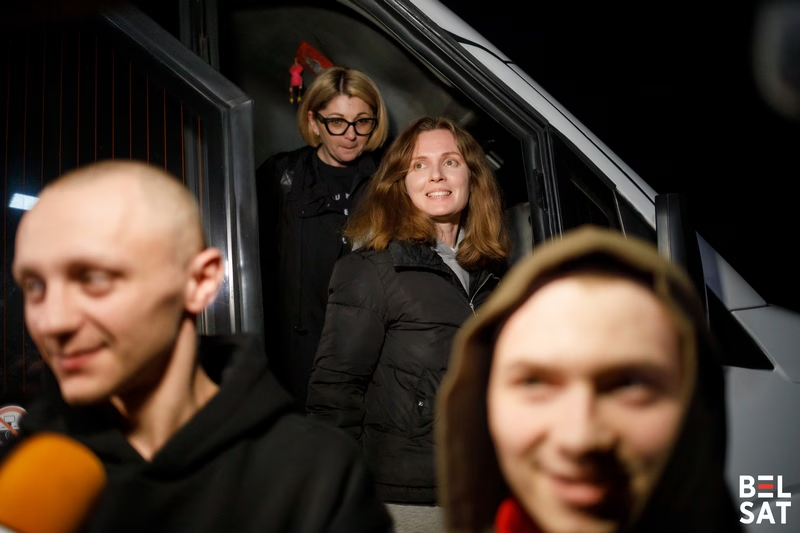
Meeting of political prisoners in Vilnius. Katsiaryna Andreyeva. March 19, 2026. Photo: Belsat
28 media workers remained imprisoned in Belarus at the beginning of 2026.
The Belarusian authorities announced the release of 250 political prisoners from custody following the US Special Envoy John Cole’s visit to Minsk on March 19, 2026. Fifteen people were deported to Lithuania on the same day, while the rest of the released political prisoners remained in Belarus. The list of deported individuals included a journalist Katsiaryna Bakhvalava (Andreyeva) and a blogger Eduard Palchys. Media workers Aleh Supruniuk, Aliaksandr Marchanka, Valeryia Kastsiuhova, and Anton Kazelski were released from custody, too.
Meanwhile, the Belarusian authorities continued to hand down severe politically motivated sentences to other journalists. In particular, six people were convicted within a three-month period.
Also, there continued systematic criminal prosecution of the exiled media workers ‘in absentia’, including the individuals, who had been released from prison and deported from their native country.
A new form of persecution emerged within the period under review. Although some independent journalists were released from custody and deported from Belarus with their documents, they noticed that their Belarusian passports got cancelled later.
Moreover, the Belarusian authorities continued to apply the ‘anti-extremist’ legislation, in order to restrict freedom of expression. Thus, numerous publications from Belarusian and foreign sources were declared ‘extremist materials’ (e.g., the Web-content of Russian BBC Service) in January – March 2026.
A new bill has been adopted in Belarus that allows the state-owned TV channels to violate copyright. Thus, they can use music without receiving the copyright holders’ consent while creating certain programs.
Criminal prosecution. Cases of detention in Belarus
The Brest Regional Court announced a verdict against Uladzimir Yanukevich and Andrei Pakalenka, the former top managers of BAR24 News Portal (formerly known as the “Intex-Press” independent newspaper) on February 26, 2026.
The court sentenced Uladzimir Yanukevich to 14 years in prison and a fine of 135,000 Belarusian rubles (approx. USD 48,900). Andrei Pakalenka was sentenced to 12 years in prison and a fine of 45,000 Belarusian rubles (approx. USD 16,300). Both media workers were charged for the alleged ‘high treason’ (Article 356 of the Belarus Criminal Code). Also, it has been reported that a huge fine of about 200,000 Belarusian rubles was imposed on them. The nature of these charges remains unknown.
The Minsk City Court convicted a musician and radio host Aleh Khamenka under Article 361–4 of the Belarus Criminal Code (‘facilitation of extremist activity’) on March 4, 2026. The cultural worker was found guilty of constant cooperation with the editorial team of Belarusian ‘Radio Racyja’, based out of Poland, and sentenced to three years in prison.
On March 6,2026, a journalist Pavel Dabravolsky was sentenced to 9 years in a maximum-security prison under Article 356 of the Belarus Criminal Code (‘high treason’). The Belarusian Association of Journalists has been updated that the criminal charges were related to Dabravolsky’s journalistic publications. He previously worked for both Belarusian and foreign media outlets, including the NV.ua magazine (Ukraine). Dabravolsky was detained in Minsk just a few months after returning home from abroad on January 22, 2025.
A journalist Tsina Palynskaya and her daughter Marharyta Rabinovich were sentenced to two years of imprisonment each under Article 361–1 of the Criminal Code of Belarus (‘creation of an extremist grouping or participation in it’).
Both of them were detained in May 2025 and kept in custody since then. Palynskaya’s husband, writer Ales Palynsky, passed away while his spouse was kept behind bars.
Reportedly, the criminal case may be related to the labeling of Prof. Andrei Vardamatsky’s Belarusian Analytical Workshop as an ‘extremist grouping’ by the Belarusian authorities. This organization conducted sociological surveys among Belarusian citizens.
As it was reported in March 2026, a political scientist and media analyst Volha Kharlamava had been detained on charges of ‘high treason’ (Article 356 of the Belarus Criminal Code) in June 2025.
She used to comment on events in Belarus and the world for various Belarusian and foreign media outlets before her arrest. Also, previously she used to work as an analyst for the Media IQ project. Volha Kharlamava is facing a sentence of 7 to 15 years in prison.
The Belarusian authorities continued criminal prosecution ‘in absentia’ against the media workers in exile. Also, their relatives were harassed by law enforcement agencies in Belarus.
Thus, Aliaksei Karpeka, a journalist of ‘Buro Media’ investigative publication learnt that he had been charged under Article 361–1 of the Belarus Criminal Code (‘participation in an extremist grouping’).
Another criminal case was filed against a blogger and a history TV-show presenter Katsiaryna Vadanosava under Article 130–1 of the Belarus Criminal Code (‘rehabilitation of Nazism, committed by a group of individuals in prior conspiracy with the use of the Internet).
The Belarusian authorities resumed criminal prosecution against the political prisoners, who had been released from custody due to diplomatic agreements. Thus, a new criminal case was filed against a blogger Mikola Dziadok (a former journalist of ‘Novy Chas’ independent newspaper and an activist of the anarchist movement).
The Belarusian authorities started selling the exiled journalists’ real estate in Belarus through auctions, in order to compensate for huge fines, which they imposed on the media workers in ‘absentia’ trials.
Thus, the exiled journalist Uladzimir Khilmanovich from Hrodna learned that his apartment and country house were put up for sale, following his conviction of ‘extremism’.
The Belarusian authorities indulged in cancelling the Belarusian passports of released political prisoners, who were deported with their personal documents.
Thus, the journalist Viachaslau Lazarau, bloggers Dzmitry Kazlou and Eduard Palchys learnt at the end of March 2026 that the Belarusian authorities had cancelled their passports. The media workers were released and deported from Belarus due to the assistance of the United States.
Censorship
The authorities continued to restrict access to alternative sources of information. Numerous publications in the Belarusian and foreign media were recognized as ‘extremist’ by them.
The Minsk City Commission for the Evaluation of Symbols, Attributes, and Information Products was established on March 19, 2026. (The creation of this commission was envisaged in a respective resolution of the Council of Ministers of Belarus, adopted in 2021. However, it was only the National and Minsk Regional commissions that used to operate in the Belarusian capital earlier.
Along with many other publications, the content of BBC Russian Service, Novaya Gazeta Europe, and the pages of Radio Liberty | Belarus in Threads were included in the National List of Extremist Materials on the basis of respective court decisions.
The BBC press service issued a statement on this occasion. Among other, it was emphasized that its employees are ‘deeply concerned about the consequences that the inclusion of BBC Russian Service on the list of extremist materials could have for the hundreds of thousands of Belarusians who turn to the BBC every week in search of the accurate and impartial information they so desperately need.’
A video blogger Maksim Shukanau was included in the List of citizens of Belarus, foreign citizens, and stateless individuals involved in extremist activities. The media worker is serving a four-year prison term at the moment.
Several Belarusian websites, including independent media outlets Nasha Niva, Reform.news, and Mediazona.Belarus, were hit by DDOS attacks on Freedom Day, which is celebrated on March 25th. It is not known who stood behind them. However, these attacks were approved by the authors of propaganda Telegram channels close to Belarusian security forces on the morning of March 25th.
‘Kind hackers greeted the exiled extremists on their holiday’, the propagandists noted. Also, they added that it was planned to make a number of independent Web-resources go to rest.’
Governmental information policy
The state-owned mass media continued their propagandist activity within the period under review.
The ‘VoenTV’ TV channel started broadcasting its programs on February 23, 2026.
It was included in the list of national TV-channels.
According to the ‘Voen TV’ First Deputy Director Kanstantsin Haharyn, ‘the new TV-channel will ‘highlight non-stop the state policies in the field of defense’, since ‘if the people’s consciousness is not armed, any conflict will be lost.’
As soon as Russia moved to the next stage of blocking Telegram and YouTube from February 10, 2026, some Belarusian propaganda media outlets, such as, ‘SB.BY Belarus Today’, started advertising their publications in the Russian messenger ‘Max’.
The House of Representatives of Belarus adopted a draft law in the first reading that provides for the free use of music which is normally subject to appropriate mandatory payments without the consent of authors or copyright holders, when creating certain TV programs by state-owned channels that are part of the core public broadcasting package. Reportedly, the permission to violate copyright was explained by the specifics of TV-production that require promptness.
In February 2026, the TikTok popular social media removed the account of Belarusian propagandist Ryhor Azaronak “Azarenok_napryamuyu”, which had more than 12 thousand subscribers. The reason for blocking in similar cases is usually connected to a violation of community rules, such as the incitement of hatred or sharing of misinformation.


 @bajmedia
Iryna Slaunikava elected BAJ Gender Commissioner
21.10.2026
Belarus adds journalist Daria Chultsova’s Instagram to “extremist resources” list
14.10.2026
European Journalists’ Soccer Tournament Opens With Minute of Silence for Mikita Melkaziorau
14.09.2026
Imprisoned videographer Yauhen Hlushkou released upon completing his sentence
24.08.2026